Hmm, it’s not that Kaneki is eager to fight, he just thinks he has to fight. He’s trying to shoulder everything on his own again, rather than asking for help from the people who are there to help him.
Kaneki realizes all these flaws within himself, but addressing them doesn’t make them suddenly disappear. Kaneki wants very badly to be a great person, but half of him is so worried about fucking up that he doesn’t commit wholly. He’s still hung up on thinking that he’s locked into a certain lifestyle, and in his head that lifestyle is fighting..
…and fighting is his only choice. He’s literally using the ghoul part of him as a scapegoat to avoid making harder decisions.
Anyway, that’s why Ayato pulled him aside: to make him actually look at the situation and consider his options, rather than just jumping in head-first. So far
Irimi told him to learn to rely on others and Ayato told him he has to let things go, so I think a major point of this arc is to have people help him overcome his flaws rather than just giving in to them.
I’ve come to think over the years that, while it is natural that Ciel and Sebastian would get most of the focus as the main characters, it often feels too much like every other character merely orbits around them, some occasionally getting the privaledge of breaking away to get close to them (Lizzie for example) before going back into their own orbit again. A lot of the time it smells of ‘because the plot demands it’.
Far too many characters only function and develop so far as it aids or impedes Ciel and/or Sebastian in some way. One can tell that the story was never really meant to have the large cast of characters it currently possesses, and so it seems Yana has a hard time focusing on anyone other than her iconic duo. Did the Phantomhive servants appear at all during this arc? I honestly can’t remember the last time we saw them! And for a group of some of the few characters that got enough development and attention devoted to them – that’s bad!
I’m coming to think that a story is truly great when you can remove one or even two of the core main cast, and the story can still hold up. The story can still carry on, because the majority of the other characters surrounding the main guy/girl or duo are just as strong, thought-out and dear to the readers.
If you were to take Ciel and Sebastian out of the picture, the entire story would implode in on itself. You would have to start a completely new story from scratch. And the only character I can possibly think of to adequately replace Ciel and Sebastian as a main lead is Undertaker. From the get-go he struck a chord and stayed in readers’ minds because he was so eccentric and consistently behaves in a manner that excites the imagination and keeps us wanting to know more about him. He could easily be the focus of his own story, starting from the beginning, of course, of his life pre-Grim Reaper onwards, or something like that.
And in regards to the 2CT, well, I don’t subscribe to it myself. I would much prefer it to be purely psychological on Ciel’s part. It’s a lot less convoluted and it makes sense considering what we’ve seen of Ciel’s mental state thus far, but that’s only my opinion 🙂
I think this was the moment when I, as a fan, just absolutely fell in love with Casca, because she takes – literally! – the shirt off her back to help Guts out. And it’s not that she’s even particularly attracted to him yet at this point in the story (or at least, she never admitted to herself or anyone else), but she would do that for anyone. Any one of the Hawks – if she sees somebody hurting, she helps them; no matter what it costs to her personally. And you can just see in Guts’ face when she does that, that he’s just seeing her for the first time.
[…] So even though it’s not explicitly romantic, it’s got that undertone there. And you also see it as a contrast, because you’ve got here the two pairings – Griffith and Charlotte, and Guts and Casca. And you see that Griffith is talking about friendship and how he values people who are equal to him, which Charlotte just is not. At all. But he values her for what she can give to him, whereas Guts values Casca because of who she is. She doesn’t have much – a scrap of cloth – but what she does have, she gives freely, and that’s the sort of person she is.
See, the thing about Touka/Kaneki is, there’s just so much emotional tension between them with so few actual conversations. Since TG:RE began they’ve hardly had any scenes together, and yet, when they are together there’s this… undeniable suspense. Which forces you to wonder what they’d say to each other if they were to express themselves honestly. So yeah. If they actually do get to talk soon… *clutches heart*
Yes and no. It comes completely down to semantics, which is why I prefer to call half ghoul/humans “hybrids”, because referring to them as only one or the other can be confusing and erases half of their identity.
Half-ghouls and Half-humans are composed of the same thing: half-ghoul, half-human. That’s what I’m trying to tell you. Arima is half ghoul, half human. Eto is half ghoul, half human.
They look different, and have different traits, but you can’t ignore the other half of their lineage just because it doesn’t show on the surface.
I’m sure a decent chunk of what he’s saying is lost in translation, but what is basically being said here is that “ghoulism” is recessive, and most half-ghoul/half-human children end up being outwardly human. The only consistency is that they have shortened lives and are capable of inhuman feats of physicality.
“Cases” like Eto are rare. Calling her a “Half-Ghoul” over a “Half-Human” is just a choice of wording.
Arima calls himself a “half-human” because he was born from a predominately ghoul family, but has predominately human traits. Arima sees himself as a failed ghoul, as Furuta described, because he was unfit to pass on the Washuu family bloodline.
Eto is the only natural “Half Ghoul” we’ve met– the rest are unethical experiments and Quinx, so it’s not fair to say “all the one’s we’ve met”. They’re all special cases, not just Kuro.
Like I said, it semantics at the moment. We don’t know the exact composition of the bloodlines in the Washuu family, whether half-ghouls can procreate, and just how complex their lineage gets. We don’t know if it’s just one kakugan that makes a hybrid rare, or how many of them can manifest a kagune even without any kakugans.
“don’t always”, meaning some can
There’s a million combinations of ghoul traits that a hybrid may or may not have (like how Arima has superhuman hearing, while Hairu is a little deaf), so you can’t just rule out the fact that a double-kakugan in a “half-human” is impossible. That’s my point with saying Rize MIGHT BE a hybrid, and not a full ghoul…
…because it hasn’t been explained yet and we just don’t know.
Long story short:
Half-ghouls have a ghoul parent and human parent
Half-humans have a ghoul parent and a human parent
Half-ghoul/human parents might be mixed in quite a lot, which further shakes up the traits that a hybrid child might have
ghouls genes are recessive
but hybrids can technically have any combination of traits, since one kakugan and the ability to manifest kagune is possible
making a double-kakugan hybrid rare, albeit possible
Frances is a seriously compelling character and imo it’s a pity that the fanon and canon seems to ignore her because she is a huge contradiction and placing her in context of the victorian era is so interesting. On one hand, you have her as the “perfect woman”, hair pulled back, dresses conservative- a prudent and model wife. She’s a strict follower of society’s rules. Then you have the badass Frances, the masculine woman who wears *pants*, the one who dabs at her husbands tears when he gets too passionate about cricket, the woman with the swords. Like she is legit seriously the matriarch of the Midford family and theres so much contradiction between the way she strictly follows the standards of an extremely misogynistic society while also turning them on their head and being an extremely empowered woman.
Like I can seriously go poetic about Frances Midford. Please give her more screen time.
I sometimes have to pay for water, but with a phone and some wifi, I get to read whole novels about my favorite characters for exactly zero additional dollars
This chapter should have been a wake up call for Ciel.
We start off with hopeful narration about those long since
gone returning to us once again. The
veil between the living and the dead is threadbare, and perhaps the prospect of
Rachel and Vincent returning to Ciel is not so far-fetched at all.
Even if that never comes true, there is still the present. There is nothing but sadness and
bitterness around Ciel. What good is
there to anything in Ciel’s world? After
all, he’s on the path of darkness, slowly losing his humanity as a demon guides
him, right?
But what do we have in this chapter?
The entire chapter revolves around Sebastian preparing a feast for the
benefit of the manor’s lowly farmers. Sure,
it could be the case that Sebastian was merely following tradition or social
obligation, but…look:
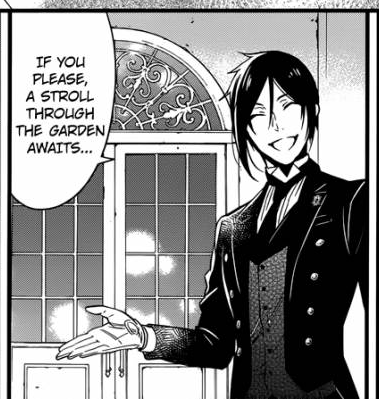
He’s just so….happy. Look at that adorable demon. JUST LOOK AT HIM.
Sebastian, with the servants’ help, goes overboard bringing a little bit of
happiness to Ciel. Why go to all that
effort to impress his little charge—the soul which supposedly grows more
delicious the sadder it becomes?
(And not only that, but in the spirit of unity, Sebastian combined
Halloween traditions from all over the world.)
Ciel is surrounded by affection. The
servants dress him up so he can be part of the festivities. Farmers thank him for his patronage. The local children want him to be a part of
their trick-or-treating.
Yes, it does remind Ciel that he has crossed over into a world that no one else knows. Yes, his reflection is there to show the past happiness he can no longer return to.
But, Ciel, you are needed in the present:
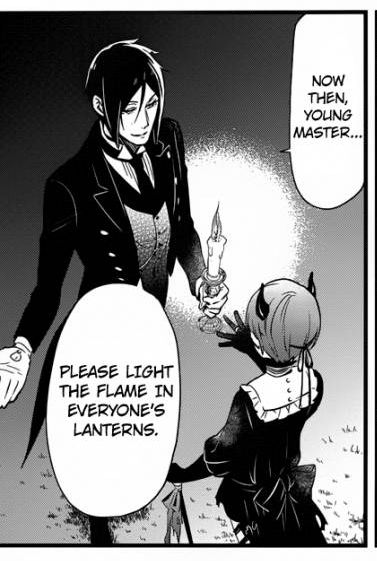
Ciel has changed lives around him for the better. His influence has spread to many around him, like the candle
flame he uses to ignite everyone’s paper lanterns. The tragedy is that I don’t think Ciel will
realize the impact he has had on those around him until it is too late.
Despite everything going on around him in this chapter, what does Ciel say?
That a weak little candle flame can turn into a raging fire. A fire of anger, of bitterness, of (self-)
destruction. Even though Sebastian, the
servants, and the guests have all reminded him not only of better days, but of
how important he is them, he turns their back on them and continues to reject
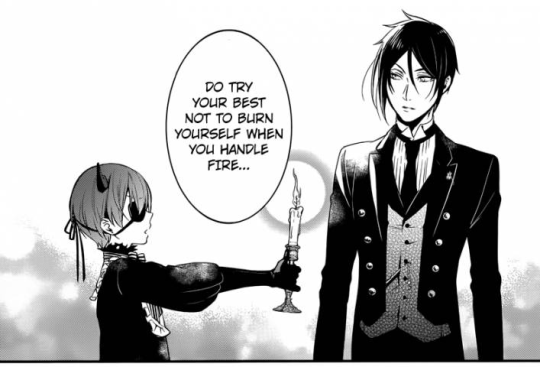
their gratitude. He even gives Sebastian
a warning not to burn himself with that “flame.” (A warning, perhaps, that Ciel may bring
about Sebastian’s destruction before this is all said and done? Or is Ciel talking about destroying himself?)
Yes, Ciel walks down a dark path.
Yes, he probably is going to die far too young. But we all must face our end someday. We cannot change that. Only the present time is within our
grasp. A situation which Ciel refuses to
accept, because he is so blinded by his bitterness.
Even Sebastian says life is a beautiful thing—perhaps because although human
life is so fragile, so fleeting, humanity still presses on to be something
better than itself, over the hills and far away. (Remember his dialogue at the end of the
Circus arc….? It still gives me chills.)
Sebastian
himself—a demon–is the one to point this out to Ciel. Ciel’s willing detachment from those around
him only results in his own self-destruction.
Either all in one glorious blaze or drop by drop, the net result is the
same: Ciel is in a continual state of destroying himself in an abyss of his own
creation.
Look around you, Ciel: people care about you. There are good things happening around you right now. Why are you so blind to that? When will you realize this?
Or maybe, a very small part of him does realize this now….





 midnight-in-town