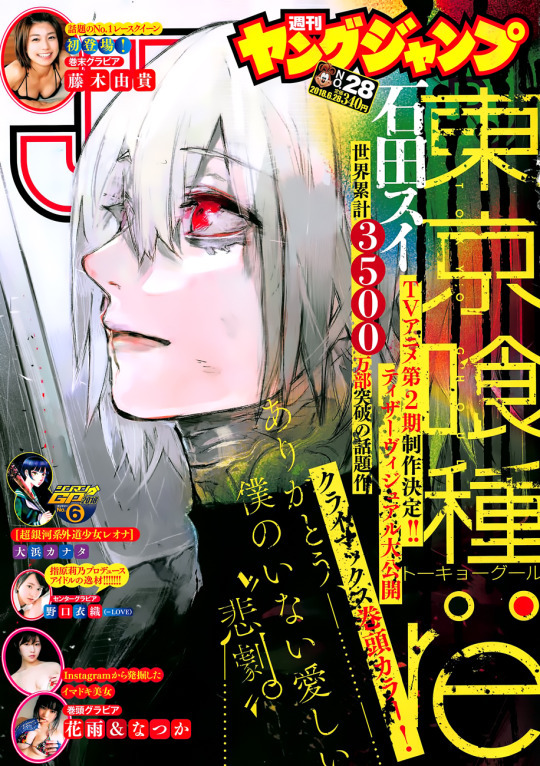
To continue from what I mentioned here, this big announcement doesn’t even seem to be about Tokyo Ghoul:re ending. At first I thought it was strange that they had this big announcement and a color cover three chapters before the actual end when that is usually when a manga gets its color cover to celebrate, but well… this big announcement was probably just about the climax and the anime. Isn’t it kind of strange that this huge piece of news about the manga ending in three chapters isn’t even mentioned on the cover of the magazine?
When last time Tokyo Ghoul did in fact end, it had huge kanji 「 終幕 」right on the left side of the cover, making it quite clear to everyone that it was in fact ending.
This new cover as far as I can see only mentions the climax, the anime’s second season, the new visual for it, the opening color page for the chapter, how many copies of volumes has been sold worldwide and it also has the caption for the picture of Kaneki, that’s it. Literally nothing else. I’m pretty sure the series ending would be the biggest piece of news they have to offer so logically it would be bound to be on the cover, right?
Forget about part 3, Tokyo Ghoul:re is not even ending.
Not to be controversial, but I’m not fully convinced Furuta is dead. Ishida has a knack for having characters seemingly die under ambiguous circumstances, only to subvert our expectations when he reveals they’re in fact alive.
Most people seem to have interpreted this page as Furuta’s heartbeat stopping (so have I at first), but that’s weird, isn’t it? :re has been about hope and forgiveness. It doesn’t make sense for the narrative to punish Furuta with death, or rather, supporting his fatalistic worldview. The two foils, Furuta and Kaneki, have been inextricably tied together and as such it would be illogical for one to receive death for his actions whereas the other gets to live. They’re both responsible for the deaths of 100 children and probably thousands of other citizens of Tokyo.
That being said, doesn’t the page above remind you of this panel from chapter 11.
During their converation, Furuta might’ve been inspired by Kaneki’s will to strive.
He even expresses his genuine desire to live immediately after that. And Kaneki even reassures him that that is nothing laughable.
Uta also mentions in chapter 11 how the rope’s condition depends on the choices made by the individual.
In other words the rope represents one’s will to strive, to live.
The black page with the white line could actually be Furuta’s rope starting to take shape. It’s in a poor condition
due to his fatalism, just a thread, but depending on Furuta’s future choices the ropes condition can improve.
(As for how and when Ishida might reveal his survival, with only three chapters left, you should read these two posts (here and here) by @sentrakk. They provide a good insight.)
I’ve had this theory for several months now, but I forgot about it due it not being relevant and just happened to remember it. I’m feeling optimistic about the future of Tokyo Ghoul now since the announcement about TG:re ending in three chapters just gave my theory even more power.
People have been talking about the possibility of a part 3, but I personally don’t think there’s any reason to introduce new plot elements and characters to the story since we only need to conclude all the unfinished characters arcs and plot threads from Tokyo Ghoul:re. I’ve for a long time had a hunch that Ishida might be following the three act structure with the manga when he divided it up into separate parts and this announcement about Tokyo Ghoul currently being in its climax and ending in three chapters might have just proved it. So this here is the three act structure:
And well, it seems to fit the story quite well. Let’s explore why:
First part was setup which did all the world building, introduced the characters and mysteries of the universe to us readers. It was the set up portion of the story since we don’t really have that kind of focus in :re anymore. Kaneki’s, the protagonist’s dilemma here is about living and finding a reason to do it, finding meaning to live in this cruel world. The first plot point, which ends the first act therefore is him choosing death and tragedy, but thanks to his life being changed drastically in part two, he find his will to live. The change brought by CCG was the thing that saved his life.
Basically Kaneki dying was the first turning point of the story and this tragic “conclusion” applied to all the other characters as well. Kaneki only fully realizes why he wants to live in the climax of the story, which is this point we are in right now, the end of act 2 aka Tokyo Ghoul:re
The dilemma Kaneki was trying to solve all this time therefore matches the three act structure and only misses the third part, but let’s look at the second act closer before that shall we:
The second act, also referred to as “rising action”, typically depicts the protagonist’s attempt to resolve the problem initiated by the first turning point, only to find him- or herself in ever worsening situations. Part of the reason protagonists seem unable to resolve their problems is because they do not yet have the skills to deal with the forces of antagonism that confront them. They must not only learn new skills but arrive at a higher sense of awareness of who they are and what they are capable of, in order to deal with their predicament, which in turn changes who they are. This is referred to as character development or a character arc. This cannot be achieved alone and they are usually aided and abetted by mentors and co-protagonists.
The first part after all never became quite as complex or ambitious as :re with what it was doing and didn’t develop Kaneki, or many other characters either in a positive way since it was only an introduction to them, the real meat of the story is Tokyo Ghoul:re, the second act. The big bulk of the character development the characters receive is in this part. The stakes keep getting higher and higher and the scale of the battles get bigger and bigger, the end even having Tokyo destroyed and Dragons. The story finally addressed the big One Eyed King plot point introduced in part 1 and it was named after it too. We also got introduced to the new main characters, the Qs and this part is longer than part 1. To sum it up, this part has way more going on than in part 1 since it is meant to be the “meat of the story” and the action constantly keeps rising.
If we look at this from Kaneki’s point of view again, Kaneki still struggles and keeps finding himself in worsening situations since he still doesn’t have the skills to handle everything. The failure of being the One Eyed King is a good example of this. He also deals with forces of antagonism since the big main conflict of the story is also in this part, which is Kaneki vs Furuta, the battle between two kings. He only ends up being played by Furuta, but starts realizing things thanks to this and his other struggles. The conflict with Furuta ended at the climax too, which is where we’re currently at.
Kaneki also finds new people that aid in him developing, which is his family at the CCG (Qs, Arima, Akira) and his old friends he reunited with. In the first part Kaneki kept spiraling downwards since he kept isolating himself emotionally and didn’t get the support he needed. This time that changed since this time everyone pushes him towards a more positive direction.
Basically everything fits perfectly, but guess what the only thing we are missing is? The resolution:
The third act features the resolution of the story and its subplots. The climax is the scene or sequence in which the main tensions of the story are brought to their most intense point and the dramatic question answered, leaving the protagonist and other characters with a new sense of who they really are.
My biggest complaint with these news about :re ending in three chapters was the fact that only Kaneki’s character arc got to a satisfying point and everyone else was ignored apart from Furuta. Basically none of the characters are in a satisfying point with their arcs, but don’t have much to fix either, most of them only really need a discussion or two with their loved ones, which would help sort their thoughts and feelings out. There are lots of hanging plot threads too, but none of those are major and don’t need much time to address.
All we are missing is an epilogue or a resolution to the story since we currently are at the high point, the climax. The climax rarely is the ending of a story and it is followed by descending action as shown with this three act structure, therefore I believe that Ishida decided to separate the last chapters of the story from :re so that he can turn Tokyo Ghoul into a trilogy that follows this structure. I doubt this part will be long, but it should be enough to give the story and its characters a satisfying conclusion.
I know I joined the despair group after the new about TG ending was announced, because there being drama behind the scenes between the mangaka and the people they work for is usually a guaranteed way to give a manga a rushed terrible ending, but… the more I think about, the less likely I find this reason to be, do we have even any proof of that apart from Ishida making a couple of posts he deleted about how manga should be free?
Ishida ending the manga here when it realistically only needed like 20 or so chapters to reach a satisfying conclusion is a joke, like quitting the marathon 100 meters before a finish line. It would’ve only taken him the rest of 2018 to finish TG and that’s not a long time taking all things into consideration. It really seemed like the 206 chapter theory was correct based on the hints we’d gotten so at this point it would seem like that idea was just got cancelled, because the manga ended prematurely, the chance of being the ending Ishida wanted to give is low, because it is far from satisfying and vast majority of the fandom seems to agree. There is no way his manga got axed like what happens to mangas with low sales and Young Jump would’ve obviously wanted to keep TG going since it sells well, therefore the only one who could’ve made it end so prematurely would be Ishida himself.
Would he have had disagreements with the higher ups and them restricting what he wants to do with the manga? Why would Young Jump let it get so bad that he quits when there’s the second cour of the anime coming out in October? This anime is just a glorified advertisement for the manga so it would be strange if the manga just ended now instead of coming out at the same time and ending at the end of December like the anime, like it would’ve been with 206 chapters. This instead is just a terrible marketing choice. And would Ishida be happy with quitting so close to the finish line and not properly wrapping his manga up? What disagreements could he have had? Ishida has said that he has free reigns to do what he wants with his manga before and popular mangakas like him are usually treated with respect instead of being thrown around by editors. What could’ve an editor have forced him to do that makes the end result look like this?
There of course could always be something going on behind the scenes that we don’t know about, but I seriously don’t believe it when TG was so close to its ending anyway. Ending it 20 or so chapters early when there’s the second cour of the anime coming out in October seems like such a strange decision that I doubt Ishida or the higher ups would want this, the fans don’t want this, nobody wants it. Only reason I would see Ishida quitting now is if he wanted to finish the manga on a different platform, but even that would be a bit strange. Anyone got any ideas why TG could end like this, because I got absolutely nothing, everything is just way too illogical. I honestly believe we’re just repeating the end of part 1 again, the series seemingly ending at the climax with everything unfinished and all questions left unanswered. Back then it at least made more sense than now since it would’ve been a tragedy. I do believe we’ll get a something like this, which wraps the manga up. Calling it :re now that the whole plot with Kaneki and Furuta is over wouldn’t be fitting so I assume it’s just going to get a new name and continue where the last 3 chapters left us off, perhaps with a minor time skip. It’s not unusual for mangas to get an epilogue/continuation like this as a separate entity either so it wouldn’t just be Ishida being extra with wanting his manga to look like a trilogy or something that consists of three acts.
Anyway, this was just me rambling, but the tl;dr is that I don’t believe that TG is over for real, because it doesn’t make any sense to me no matter how I look at it. It doesn’t even look like the typical scenario where a mangaka rushes their ending and quits or the higher ups ax it. They’ve already tricked us with the ending of part 1 so I expect this to be the case again. This is just my opinion though, but I’ll wait and see what happens, because I’m pretty sure we’ll get a bit more than just three chapters.
To add more to this, isn’t there usually an announcement beforehand about what volume the manga ends on or a date or something? We were told we’re currently in the final arc months ago, but now we only get a date 3 chapters before the supposed end, it’s way too sudden and suspicious. This decision to end :re now will have to be a bit older than something decided yesterday, it just doesn’t work like that.
This is basically the same situation as Gintama for example: we are told that we’re in the final arc -> a big important announcement about the climax is made -> people panic about the manga ending -> the climax and the big final boss battle happen -> what actually follows is something that might as well be an arc of its own and wraps everything up in a satisfying way (and this has been going for 17 chapters already) I assume they’ll soon make the announcement about the specific end date/volume. Based on the ending of chapter 176, it seems like the last three chapters will be about Kaneki vs Rize and I’m quite certain it will end at the final chapter kind of like the Utsuro thing in chapter 668 of Gintama. So it is the “final boss battle” before the resolution.
I know this doesn’t prove anything, but I thought it was funny that even the color covers/pages released during the climax are almost identical with an optimistic caption about future and moving on
I don’t know, I feel like this Kaneki cover is intentionally teasing the resolution that we will get to see. Also it’s kind of funny that TG:re got the cover now when usually a manga gets its color cover with the final chapter to celebrate the ending, not three chapters beforehand.
Like, TG is not ending yet.
(I might look like this when rambling about this, but trust me, I’m serious)
Thank you…my beloved tragedy that I am absent from[x]
that line from Kaneki on the cover illustration makes so much more sense now.
he no longer looks at his life as a tragedy because it was worth it all to find happiness in his life.
So “thankyou” to the beloved tragedy that he is no longer a part of, because it brought him to a place where he belongs with all his loved ones.
Don’t you love how the first TG ended up with Kaneki’s tragedy while things were going fine for Furuta (he was a laughing Clown), when now in :Re it’s the other way around?
it’s a small thing but i think my favorite little detail of this whole chapter was rize’s background “i don’t want to be a grandma” line —
it’s hard to describe, but i appreciate that even in furuta’s happy past memories, even though rize legitimately looks to have enjoyed herself with him, it also looks as if she never once played along with his desires, and was always transparent with her own. ✨ (making furuta’s dream of a normal life with her even more unattainable, even outside the short lifespan thing, which lends, to me, a flavor i like, at least in the sense of building furuta up as even more hopeless and villain-y)
THIS THIS THIS.
Rize has always been upfront about things, at least when she wasn’t actively playing a role (hunting, pretending to be clueless). She states her feelings, her desires, and her interests without holding back.
Even so, the men that she dealt with have tended to project their own ideas on to her.
Furuta had this whole childhood romance ideal, even while Rize was giving enormous signals that she didn’t want any of that nonsense.
Banjou wanted her to use her strength to the advantage of everyone as a leader, but Rize shot him down.
Kaneki projected his most violent thoughts and his strength on to her, rather than admit they were his all along.
This whole thing reminds me of how the normal response to a woman stating she doesn’t want children is for people to reassure her that she’ll change her mind.
Furuta was doomed from the beginning, not just because of his shortened lifespan, but because he clung to a dream that wasn’t mutually desired.
Small detail, Furuta touching his chin when he was completely honest for the first time was a nice contrast to Kaneki’s habit of touching his chin when he lies.


 midnight-in-town