So, a lot of people when reading Furuta’s character tend to mitsake what is a deliberate act on his part, for his genuine personality. That Furuta is all the negative traits that he portrays, all the silly traits that he portrays, and therefore a shallow villain filled with nothing but a desire to destroy everything because he sees no meaning in anything.
And at that point you’ve fallen for the mask. Furuta’s identity is splintered, as any character who played so many roles and forced themselves into so many roles would be. People tend to mistake Furuta’s negative traits as stemming from malice, hatred, misogny, misanthropy, a narrative of toxic masculinity, when one of Jungian Psychology applies better to him when you read Furuta as a character deliberately exaggerating the most negative aspects of himself not only to highlight those qualities in his portrayal as a villain but also in the system around him.
he inconsistency in Furuta’s personality, the hypocrisy, it can be read in another way as a deliberate act. A narrative of dissociation and pslintering of his identity, though in Furuta’s case much more deliberate on his part than on Kaneki’s works just as well when reading his character. This is a part of Furuta’s characterization because it connects to Kaneki, it was established with Kaneki before Furuta was even a proper character in the narrative.
Kaneki is a character who seems shy and yet somehow when others have expectations for him, he can suddenly become confident and play the role as expected. Kaneki when interacting with others changes himself to conceal a part of himself, always wearing a mask to cater to their expectations.
The difference lies in the central motive between the two characters, Kaneki wears a mask to get people around him to believe in him and love him, Furuta wears a mask to dehumanize himself because there is a job that he must accomplish that he can’t hesitate, show a sign of weakness, or let his face betray his true intentions because he’s caught in a web of conspiracy. (A literal web because V is symbolized by butterflies, the symbols of life hope and change in Tokyo Ghoul, caught in a web).
The persona, for Swiss psychiatrist Carl Jung, was the social face the individual presented to the world—"a kind of mask, designed on the one hand to make a definite impression upon others, and on the other to conceal the true nature of the individual" [x].
A persona is a mask that changes depending on a situation. The simplest way to explain it is that you would not swear in front of your grandma, even though you normally swear in front of your friends. Personality is a flexible thing and people act differently depending on different situations, or rather they present different parts of themselves.
In video game terms in the persona video games you have twenty four social links based on the arcana, and in each social link you basically cater your answers towards what the other person would like to hear. The answers you give to a relaxing and easygoing character’s social link are different from the answers you would give to a strict and serious character’s social link, which is why the protagonist is silent, they’re a person that everybody can get behind because that person really caters themselves to different situations and wears a different mask depending on the person they are talking to which they thinks will best suit that person.
If it’s easier think of Furuta like a persona protagonist, they have to change themselves based on the situation to get what they want. That’s why it’s important to get the outside context of the situation.
One of Furuta’s first scenes after his introduction, note he plays the role as bait flawelssly and then just as easily switches back to his normal self. Kijima even compliments him “That role is perfect for you” In that he’s a natural distraction.
The first role Furuta plays is a harmless errand boy that nobody pays attention to because he’s always in the shadow of Kijima. Then, when Kijima dies we get a glimpse of his true self.
Notice what the first thing he does. It’s exactly what Okahira asked him to do “Stay behind me.” The moment he gets the order, Furuta twists it ironically on its head by using him as a human shield. Remember in the CCG, there’s a pecking order and a hierarchy. It’s seen as heroic and good for agents to stay behind and die for the rest of their squad. This is how Urie’s father died. Not only that but beforehand Furuta was playing the role of the perfect CCG underling, partnered with an advisor and always following them around and going around with them no matter what they did.
He’s basically Amon to Kureo in part one. Kijima was supposed to mentor him. Yet, Kijima is a crazy person with a chainsaw who unilaterally applies torture to ghouls to get what he wants. He’s bloodthirsty he just only directs it towars ghouls. Yet, we’re supposed to read it as shocking when the guy who always follows Kijima around turns out to be violent as well.
Furuta’s still playing the role of a CCG agent, he’s just turning it on his head. These guys are surprised that the guy who always followed Kijima around is violent, because they tolerated his violence, because the system tolerated his violence and they did not really see themselves as violent. The ending of Furuta the CCG agent, he plays the role perfectly, he shows no empathy for a ghoul, and then he mourns his advisor.
Even when wiping out the rest of the CCG members in the room, Furuta says that they have to report because that’s what a good CCG agent would do. THey have to continue following duty, they’re bound to duty.
Furuta’s masks aren’t just there to be confusing and edgy, they’re purposeful, they’re intentional parodies. Furuta’s role as a ccg agent is the extremes of how ccg agents act, either completely cowed to the violent atmopshere around him to the point of enabling people like Kijima without speaking up, or violent and heartless towards ghouls who are nothing more than man eating monsters so therefore whatever emotions they fight with or whoever they fight to protect does not matter. They’re a critique of the CCG agents he’s pretending to be. How violent was Kureo Mado towards other ghouls, even women and children and how much did Amon just sit there and watch without interrupting or doing anything.
Yet, at the same time a part of Furuta slips out with his masks. You can easily interpret what he says “You can try to cover it up all you want but in the end you’re just a man eating monster” as about the Washuu as well ghouls who pretend to be human, and ghouls with money and influence just like the Tsukiyama. Who pretended to be human and claimed they wanted to be captured and meet their end as humans and yet with a portion of their wealth did things like attending human auctions and covering up Shuu just killing people at random.
This is also a good time to notice that Furuta slicing up parts of his personality and presenting them like masks means there is sometimes a lack of his central personality. It’s important to remember that Furuta was not raised as a human being, he was raised as a child soldier, he was raised for a role from the beginning not a child to be loved so even in his formative years there was not much to give him a personality of an individual person and not a cog in the system. When Furuta’s profile is revealed he seems to be a nobody, no age, no honors, and no hobbies or interests in particular when even a bloodthirsty guy like Kijima likes to tap dance.
Not only does the act of wearing masks wear away at Furuta’s original personality, he also actively suppresses any trace of humanity inside of him so he can better fit the roles. Once again Furuta is caught in the middle of both the Washuu and V’s machinations, if he slips he would have just been erased and killed. He has very heavy pressure not to hesitate, second guess himself, or act as a human would and not a machine that’s bent on destroying the system around him.
I also think Pandora Hearts explained it in a much clearer way with the character Jack Vessalius who parallels Furuta in a lot of ways.
Furuta, continually dehumanized, by the system and then by himself eventually splinters and tries to dissociate his own humanity from himself until all that remains of him is a pile of masks that he stands on, united together by a centralized goal of destroying the Washuu.
The next Furuta we’re introduced to is V Furuta. This is how Furuta is demonstrating that the Washuu and the agents of V act to the audience. The Washuu a patriarchical, heterosexual dominant chain of command that enforces that power structure on the CCG as well.
I mean look how Matsuri acts with Urie.
Or the way Matsuri has to act as family head.
Power, dominance, control with sexuality mixed in as well. Not to mention later on it’s revealed Furuta was raised in a literal rape garden. So there, Furuta is emulating the dominant culture of the Washuu. He spouts their philosophy like he’s nothing more than a loyal follower of the Washuu.
However again a grain of truth is mixed in with Furuta’s dialogue. (Also notice that Furuta often adopts different personas visually when explaining these bits of exposition as if he’s acting them out like an actor on stage. This is genuinely how Furuta believes people will act, they don’t care about the truth, they need to be manipulated, cajoled, they need to be convinced through scapegoats rather than to act on their own.
For the biggest hint that this is all an act Furuta straight up says “You even had to kill your father tsk, tsk, that’s the worst thing to do” and then kills his father 30 chapters later. Loyal V agent Furuta, just a cog in the system, spouts the rhetoric of V, gets off on the tiny amount of power he has working behind the scenes the same way that Kaiko does. Then Eto dregs up a tiny bit of his humanity and look how he acts.
He has an uncontrollable flashback on the level of a PTSD flashback to one of the more human moments of his youth, and a reminder that he was a bred child and then goes actively right back to suppressing his humanity.
Because for Furuta humanity is bad, it makes him lose control and act irrationally.
So one quick detour for Souta the clown, he’s introduced in the Gourmet club the most inhuman of ghoul activities shown in the manga besides the Auction hall, and he acts basically the same way Tsukiyama does. Reveling in his ghoulhood, mentioning how fun others would be to eat, only pretending to be human to string along a target that he wanted to eat, basically the way that all ccg agents think ghouls act that they simply pretend to be human and have human emotions and are heartless killers only concerned about eating.
The clowns specifically as well revel in their roles as outsiders and embrace their monstrosity, claiming that since the world will never sympathize with them there really is no reason to act sympathetic. This is just a brief aside though so I can’t get into the entire clown dogma, but there is a general theme of suppressing your humanity and playing the role.
The world will never love us as much as humans no matter how we pretend to be so why even pretend, why engage at all. This is especially relevant for Furuta who can never be fully ghoul and never be fully human because he was born as a breeding experiment. If he had conformed to the CCG’s desires he would have died as fodder like Hairu, or many of the other nameless V agents, or died young regardless.
Then finally moving on to Kichimura.
The first mask he wears is a party mask, because that’s what they’re doing at these promotion ceremonies, throwing parties to celebrate how many people they killed.
Then in one chapter, Furuta as the chief brings everything to the forefront. The CCG actively recruites from orpahned children. They actively pressure those orpahned children to go into human experimenation such as Shirazu being finanically pressured to accept the Q’s surgery or his sister would die, Mutsuki getting a murder sentence suspended because he would make a good tool for the CCG.
Peace on Death is not even soething Furuta originally said. It was said by Marude, let’s kill all those ghouls and give them peace with death.
The traits which Furuta shows in his performance as Kichimura were all present in all other heads of the CCG. The mission from the beginning had always been mass extermination of ghouls, there’s literally a law that says every ghoul captured must be killed. Amon says multiple times the world is twisted because fo ghouls and he wants to get rid of all ghouls. Urie says that in the first chapter we need to get rid of all ghouls. This is dogma parroted by the CCG over and over again.
Tsuneyoshi and Yoshitoki simply dressed it up, claimed it was just a job, something they had to do. Furuta pushes it to the extreme so people cannot ignore him.
“It’s just a job” for the same reason V agent Furuta parrroted “this is all just to maintain balance, it’s necessary.” The CCG is so blind that literally when Juuzou says “I’ll massacre everyone on the bridge” somehow one member of Juuzou squad says “they’ve managed to make us feel like murderers.”
Then finally, the conversation in 101. Why does Furuta act the way he does in front of Kaneki. So, the first thing Kaneki does is after establishing himself as Furuta’s opponent say “I wanted to talk with the Washuu.”
Furuta even says this. “I had the clowns do a bit of acting.” he’s already staging the role. He’s scoping things out with Kaneki, Kaneki to be his hero and Furuta to be the villain everybody unites to defeat.
So, if Furuta wanted the same thing as Kaneki, the destruction of the Washuu, coexistence, why didn’t he just state it? Why did he antagonize Kaneki on purpose? And the answer is quite simple.
“I wanted to talk to the Washuu.” imagine you’ve been planning your whole life to overthrow the evil family that bred you, raised you as a child soldier, and having to betray and stomp over others all this time to get this far and secure this one opening and you’ve finally killed the family that’s oppressed you your whole life.
THen the person whose been chosen to lead the violent ghoul revolution that definitely needs a plan to improve the world goes. “Oh I was just going to talk to them.” like he’s just winging it. He’s scoping out Kaneki, and he realizes right away Kaneki’s not serious about this. So, Furuta defaults to what he believes, that people will not act unless they’re cajoled into it, that they need narratives to act, that they need to be manipulated with stories, stage trickery, and spot lights rather than being convinced to care through empathy. He basically tells Kaneki what he’s going to do, create a great enemy for everybody to unite and fight behind and that it’s all scripted beforehand. They’re all playing roles.
Then, Kankeki during his scoping out reveals his real reason for doing this. It’s about him, not about destroying the Washuu, hence why he has no real plan.
Then, Furuta explains that he’s a bred child soldier that he was going to fight all of his life in servitude under the Washuu until he died a useless pawn and Kaneki still doens’t get why he might want to overthrow the Washuu. So, Furuta puts on the mask he’s expected to in this scene.
‘I DON’T CARE I’M DOING IT FOR THE LULZZZZZ” because Kaneki doesn’t even want to try to see what Furuta’s motivation might possibly be. He can’t put together that a child soldier might want to free himself from a system that created him.
Furuta reveals one small part of his humanity, that when he was a child there was somebody he had a connection to, that he cared about.
Then, immediately the mask comes back on. LOL NO ACTUALLY I’M A CREEP. I JUST WANT TO MARRY RIZE THERE’S NO MORE COMPLICATED REASON THAN THAT.
Furuta knows his actions towards Rize were monstrous. He did it to sever away that human portion of himself, to become the mask, to not care about anything and prove that he’s a monster and every time he slips and pretends to have actually been a human at one point in time he reasserts that he’s a monster even harder, he doubles down on the act and exaggerates the worst parts of himself because that’s how he sees himself too. He wants to become the mask, because Furuta the scared garden child who did one good deed can’t possibly bring the whole system down.
Furuta says in his most honest moment. I decided I’d destroy everything, his whole life devoted to that goal, and thus he had to do terrible things, fit himself into roles without ever giving away his true motivation, all to accomplish that.
So if Furuta acts inconsistent, acts inhuman, it’s on purpose, it’s a mechanism to deny his own humanity and better fit the role he’s playing by necessity in order to accomplish his goal,
I’d like to start of with this quote by Touka in the novels.
“What the hell do you know? It’s all because I can’t eat, because I could become a target at any time, all because I’m a ghoul! No matter how much I try, there’s a wall I can never jump over, and there’s happiness I can never have. But I’m still hanging on to life. Despite it all”
Followed by this from part 1.
And of course this from Yomo.
As you can see there’s a pattern, and if I wanted to I could indulge you with a fuckton more Touka quotes/panels to further exemplify these, but I digress because I ramble too much and words alone aren’t enough to truly encapsulate everything in its entirety😒.
Alrighty then, let’s get this long rambling journey started! I dub thee:
“Strength in weakness and Weakness in strength”
What makes Touka such an interesting character for me in terms of her writing is that there’s a lot of nuances to her that make her so fascinating to read. Because of these elements, I feel as though leads to a general misconception/misunderstanding of her character in favor of either completely overlooking or simply dismissing them and marking them as purely simplistic and well… not important/uninteresting. I for one believe that there lies a profound complex simplicity and simple complexity of sorts to a lot of these nuances that can be very easy to miss, but are of crucial note to consider, most especially the subtleties to her growth in :re alongside many important thematic elements of the story, other characters and herself.
He might have just… never developed one tbh. Ongoing cannibalism (and the massive influx of RC cells that goes with it) can trigger the mutation but it’s not an inevitability; apparently it’s pretty rare. Plus there are ghouls, like the Tsukiyama family, who cannot develop them for genetic reasons – there’s nothing in the text to suggest Yomo or his family share a similar trait but I guess it’s a possibility.
I really like the idea that he can produce a kakuja and chooses not to though – he and Arata were headed down the exact same path, and it took Arata’s death/Touka & Ayato’s abandonment and Yoshimura’s patronage to show Yomo how destructive and pointless his need for revenge was. Rejecting the power he was able to amass in the way of a kakuja would be a nice symbolic nod towards his character development, and I think ensuring he was able to protect his niece and nephew without the destructive power that killed Arata brings with it a sense of atonement for what (Renji feels) he forced their father to do.
It’s also thematically kinda cool considering his advice to Ken: that everything he accomplished was through his own strength and not through the strength he was ‘borrowing’ from others (Rize, Yamori). Forming a kakuja necessarily requires one person to ‘steal’ [kill and consume] from others and, unlike Kaneki (who was a victim of Rize, Kanou, Yamori), Yomo was an aggressor. He probably orphaned kids just like Touka and Ayato.
Choosing not to use a kakuja, if he’s able, could be an acknowledgement that his earlier actions were wrong or selfish; or evil, if we’re going full Kuzen.
He still does become insanely powerful but he’s strategic and incredibly well-rounded rather than being just another big ol’ one punch monster. Even Mutsuki calls him a perfect ghoul, and he defeats his equal even though Uta DOES resort to a kakuja in the end.
When Uta says “you’ve become really strong, Renji” after their final fight, he means since Ren left the 4th Ward – it’s a different type of strength, beyond whatever he was pursuing before Anteiku. He’s become strong in spite of the path he was on in his youth, not because of it.
So, this post is a really long time in the making. A lot of my recent hiatus has been fine tuning my thoughts for this post. Consider this my final meta for Tokyo Ghoul if you would. This is something I’ve wanted to write about for awhile, because the vast majority of the fandom seems to be a misconception among the fandom about Furuta and Kaneki’s foiling, that Kaneki in fact has nothing in common with Furuta and is a hero to his villain. That the only shared aspect between them is loneliness and that Furuta is just an example of what Kaneki would be without loved ones around him.
However, as the 101 title page suggests the characters are actually deeply connected and intertwined to the point that when they become too close it can be difficult to tell where one ends and the other begins. All of Kaneki’s unhealthy habits, perceptions, flaws are mirrored in Furuta, but in Furuta’s case they are framed and made much more clear. It’s only by acknowledging how much Kaneki and Furuta are alike you can see the whole of Kaneki’s character, the good and the bad. With a close and analytical reading you can pick out all these connections which is what I’m going to do below.
I just love how this quote from Touka in the Tokyo Ghoul Days novel played out in the whole series.
All that fortitude, sheer will, faith, resolve and strength paid off. Throughout all the pain she and everyone suffered, the whole living while losing things mentality was broken! She just wanted to live a normal life with everyone away from the constant cycle of pain, war and bloodshed between humans and ghouls due to the tragic nature of the world. And she was finally able to reach the happiness she never thought possible.She was finally able to gain her wish of living a normal life as a ghoul with humans, and all her loved ones.😭👏
I talked about this, briefly, via an ask on my old account and then immediately deleted it. At the time, I just wasn’t in the mood to bring up and fan what was rapidly becoming a big sore spot for many in the fandom. I disagree with the idea that she’s become a “”reduced”” character for many reasons, but I think one of the major contributing factors to what upset people might just be because in 300+ chapters, some little bits and pieces of Touka’s character might’ve been missed or forgotten.
That being said, I’d be remiss if I didn’t acknowledge that media doesn’t exist in a vacuum and I’m not striving to argue whether or not Touka’s character was treated well as much as I want to talk about her. She’s my favorite character, after all, and the primary reason I got into TG all those years ago.
So call this a Character Study, if you will.
TL;DR: Touka got exactly the ending she was striving for
To explain simply, while thinking about Touka’s pregnancy this afternoon, I realized something I hadn’t noticed before:
See, the reason Touka’s body has the risk to mistakenly recognize the baby as nutrients and absorb it is because, as a ghoul, she feeds on RC cells and…
humans have a low rate of RC cells
=> human meat is edible! (and tasty :D)
ghouls have a high rate of RC cells
=> ghoul meat is edible! (but disgusting, ew :/)
which means that human, ghoul and hybrid babies (like Touka’s) have RC cells too!
..But then in that case (which is what I realized today), how comes that only a hybrid baby has the risk to be mistaken as nutrients by its ghoul mama when a ghoul baby also has RC cells? In other words, why is Touka’s body possibly going to recognize her baby’s RC cells as food when her own RC cells in Hikari’s womb weren’t?
Hi Anon and well, logically that’s what you’d think with what I said above, isn’t it? 🙂 However, since I’m pretty sure that Sensei won’t kill that baby, if somehow I’m correct (big big if there), then there must be a catch somewhere.
I do have a theory to answer you, the problem is that…
Itori possibly losing her own hybrid babies in the past is not 100% helping me.
See, initially with what I explained above, I was considering the following: Touka aside, the common point toall the previous hybrid pregnancies in the story is that the mothers always were humans. Eto’s ghoul parent was Yoshimura…
and for the sunlit garden, the father of every child in there (be it “half human” like Arima, or ghoul like Rize) is from the pure Washuu bloodline who are, as we learnt recently, kakuja ghouls from birth.
However, now we have Touka who is the ghoul parent of her hybrid baby, which makes her case pretty unique so far in the story (Itori aside). Touka who, as a ghoul, is supposed to be eating a lot of RC cells both for her sake and her baby’s, but who also has higher RC cells rates than a human mama, as well as a kakuhou to regulate these high rates.
In other words, her own RC cells needs (and body rates) are different from a human mama carrying a hybrid. That’s why her case is interesting, because the maternal environment that she provides to her hybrid baby is different from what Arima’s mom provided to fetus!Arima, or what Ukina provided to fetus!Eto.
=> so my theory is that the maternal environment during the pregnancy plays a part into the development of the kakuhou for hybrid fetuses.
In the first place, kakuhou development is correlated to high RC cells rates, which is the difference between humans and ghouls as @mawjaw explained here; that’s also why ghouls can develop multiple kakuhou in order to regulate their high RC cells rates, when one kakuhou on its own is overwhelmed.
Anyway, so far in the story, we got numerous examples that a hybrid baby carried by a human mama has more chances to be born as a half human (no kakuhou) than a OEG (kakuhou), and it’s interesting because the human mama herself has low RC cells rates and thus no kakuhou in the first place.
So in Touka’s case, the fact she’s a ghoul means that she needs to eat a lot of RC cells, that she has higher RC cells body rates and a kakuhou, which may just favorize the kakuhou development for her hybrid baby.
In other words, a maternal environment
exposing the hybrid baby
to more RC cells because the mama is a ghoul (or in Ukina’s case, because she ate a loooot of human meat) might just positively influence the development of the baby’s kakuhou (in order for baby to regulate all the RC cells reaching it).
And if Touka’s baby develops a kakuhou, then my theory above that it will protect the baby from being seen as food by Touka’s body works too. 😀
In conclusion, about hybrid pregnancies:
mama = human = no kakuhou
maternal environment = low RC cells rates
=> “half human” baby (no kakuhou) more probable than OEG baby (kakuhou), because no need for baby to regulate RC cells while in the womb => Arima.
unless mama eats a lot of human meat and increases the RC cells rates in the maternal environment => that’d be Ukina & Eto.
mama = ghoul = kakuhou
maternal environment = high RC cells rates
OEG baby (kakuhou) more probable than “half human” baby (no kakuhou) because there is a possible need for baby to regulate RC cells while in the womb
OEG baby’s kakuhou will then provide protection against being seen as food by the ghoul mama’s body
That’s the theory. However, as I was saying, Itori might be failing me here, because TG ch34 seems to imply that she might have lost her own hybrid baby/babies, meaning that it’s probably quite complicated for hybrid pregnancies to succeed at all. So I don’t know
¯_(ツ)_/¯
maybe hybrid pregnancies will fail more often than regular pregnancies in general (which would mean that Itori is right when she says that the chance of successful pregnancy in itself is extremely slim)
but when they’re successful, the baby’s nature as a half human or OEG is strongly correlated to its mama’s nature, because kakuhou development is also
mediated
by maternal environment.
I really think Sensei won’t kill off that baby, so there must be a way for Touka to make her pregnancy viable and I’m just rambling around with all my ideas. :3
Still I hope it made sense, thanks for reading Anon and have a nice weekend. 🙂
Anon-chan, for everyone’s sake I’ll make this extremely simple. :)) If Touka’s baby can be born then, according to the theory above, it means that:
it will most likely be a OEG
it will most likely be heatlhy/okay and Touka & Kaneki will be happy parents!
Here are the two possibilities for Touka’s baby in my opinion, considering what I said above (please keep in mind it’s just a theory and I could be totally wrong):
In terms of probability though, I guess it depends on if you’re taking Itori’s words seriously or not. She said that chances for a successful hybrid pregnancy are slim and frankly, I don’t think she’s lying.
Besides, in a human mama’s case, both half human and OEG babies can be born, it’s just that she’s more likely to have a half human baby than a OEG. Whereas in Touka’s case, in this theory it seems the only way for her baby to survive in her womb is if it’s a OEG, which is what Itori probably meant when she said that chances of success were slim.
I’m sorry it sounds so hella complicated, but I hope this sums things
Not explicitly. However, it’s all but confirmed that she gave those flowers to Shinohara, as Juuzou remembers finding them there when he’s about to fight her.
The bouquets are also identical.
Touka met Shinohara along with Juuzou at Anteiku. Juuzou recognising her, and her seemingly remembering him, reminds us of that:
Just as Shinohara recognised her back then:
She must have heard about his condition following the battle against Yoshimura. Even though he was fighting against the manager, Touka was sorrowful for his loss as well.
This is a sign of her growth in feeling empathy for both sides rather than just looking out for her own. This empathy is embodied in her creation of :re; like Anteiku before it, it is a symbol of human-ghoul integration, a peaceful haven for ghouls in the heart of the human world. She is following in Yoshimura’s footsteps in her care for Shinohara as well.
Though I doubt that she knows it, Shinohara was also involved in the death of her father, which is why he recognises her on his visit.
So the gesture has even more significance than she may be aware, since the death of her father was the reason she began to resent humans in the first place. As we see in 120, now she acknowledges that he brought his death as much upon himself in his bloody crusade as the humans did.
So it’s a big gesture signifying Touka’s development into a more empathetic and understanding person, if you look between the lines.
Yes, I have a lot of these asks in my inbox so I hope I can cover them all in one go.
Alright I am going to do my best dissection of the last chapter. This is strictly from an interpretive perspective and not an opinion based one. Opinion based I have no real strong opinions on the ending beyond “it sure was an ending.”
I’ve already come out and said I was expecting an ending for Tokyo Ghoul: Re for a long time and got pretty much what I was expecting leaving me mostly neutral. I’ve also avoided talking about it for around two weeks so. There is the disclaimer.
So more than anything else I read the ending as bittersweet. Remember this was not a peace achieved by diplomacy, but rather by the forming of a common enemy. Not only that but the common enemy is literally compared to “newborns” and “orphans.”
I made a meta a long time ago, you can read it [here] that those the most abused and mistreated by society are also those who end up being scapegoats and forgotten. The oggai are all thirteen to fifteen year old children who were turned into child soldiers, mainly because there was a system in place already that adopted orphans and manipulated them to hate ghouls, and so their deaths go mainly forgotten by the story to reflect their status in the world. Of course the Oggai are forgotten and not even mentioned in the epilogue, they were orphans, there was nobody to remember them in the first place.
This isn’t a criticism this is reflective of a theme. Those who are the most abused by society, those who are the worst victims, those who are manipulated often aren’t saved. We see that time and time again in Tokyo Ghoul and it’s even heavily present in the epilogue.
I am arguing author intent here, that Ishida left those elements in to purposefully make the ending bittersweet, or even melancholy. I’m not even specifically talking about who to blame for the deaths of the Oggai, just that in a better world steps would have been taken to make sure the tragedy never repeats itself again. However, the ending shows us that is not the case because the world of Tokyo Ghoul is not a world that’s been reborn anew after being destroyed but one that slowly changes after great fighting.
A lot of the problems of the CCG still persist, even if they’ve been reformed and renamed. Just the strongest shining example is given to us by Ishida himself. Six years after the fact, after the supposed reform of the CCG, nobody still thought to fire the teacher with an obvious history of abuse of prisoners and children. Which means that the CCG academy that acted as a pipeline for orphans to be made directly into good CCG officers is still mostly in tact, and also that once again the CCG values efficiency and skill over actual ethics. Tokage gave a knife to Mutsuki and told him how to better kill cats, but if the CCG had raised Mutsuki with the intent of allowing a damaged orphan to re-enter society rather than just raising them to be another weapon to point at ghouls then they never would have allowed Tokage to stay employed by them in the first place. The fact that Tokage wasn’t simply fired and that an actual child had to stab him to death before they took any action shows that this part of the CCG still stagnates.
There’s also CCG branches that are still, just the normal CCG and not the reformed TSG that cooperates with ghouls. It’s also quite obvious that the characters who were the least sympathetic with ghouls (Kuramoto and Mutsuki in particular) transferred there and just act like normal CCG officers, and not reformed TSC officers who fight side by side with ghouls.
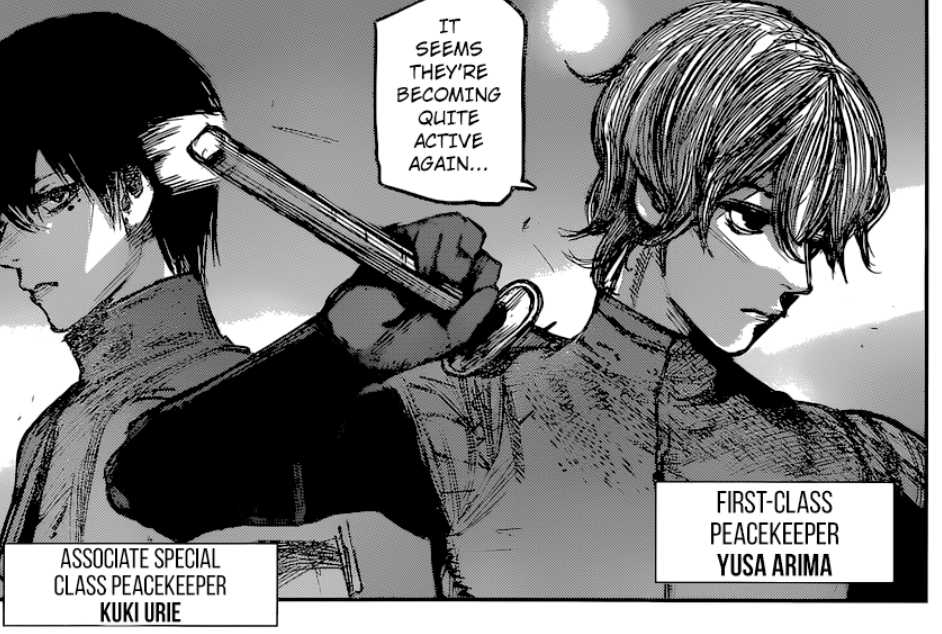
Yusa’s fate is rather sad as well. I don’t think I’m alone in saying pretty much everybody wanted the zero squad and garden kids in general to escape the CCG and be able to live a normal life. There is a lot of fighting to do yes, but perhaps it should be handled by the people who were not raised as child soldiers.
Yusa Arima in particular seems like a tragic example of this. It’s said quite clearly that he wanted to exist in the world outside of battles, yet we see him in the epilogue.
Not only has he remained a CCG officer, he’s fighting even while undergoing early aging. People are even trying to honor him by fighting until he reaches an early grave by putting the name Kishou on him, but that’s quite literally missing the point.
Arima’s wish was to escape the fighting, so it’s rather tragic the last living member of the garden kids in zero squad isn’t really given that opportunity at all. Rather, he’s fighting until his hair grays and people start calling him a second Arima completely ignorant to the wishes of the first Arima, but again this was built up.
Are we ever going to reach the perfect world Arma wished for? Or are we stuck currently in the one we’re in, that was the last ambiguous note that Yusa’s arc ended on.
So continuing on, I made a big deal on how a society that was better would at least make sure never to repeat the mistake of the Oggai, but what we see here is a continuation of the Q’s.
No questions asked from the one hundred Q orphans that specifically exploited this program and the science behind it to not only kill 100 children but create the monster that was dragon, well they make good weapons so might as well make more of them.
Considering that a few of the test subjects are also garden children who probably were child soldiers who can’t consent to this operation that much, I would say the fact that more Q’s are being produced is definitely meant to be read as shady.
This is specifically what Furuta says in “Good News” as well, that the Oggai are the next generation Q’s, as in they are what the Q’s are in danger of becoming. Knowing that, learning from the horrible destruction of the Oggai any organization really should have halted the project entirely but that’s not what we see happen. The dangers are ignored because they make convenient weapons.
So, finally the “There were ghouls that continued to rail against humankind.”
Using Shikorae as the example of the most dangerous, most inhuman ghoul possible just underlies the point of what I said earlier that Tokyo Ghoul depicts a world where the weak and abused are still scapegoated and forgotten about. That is the entire point of Rio’s character, he has a video game where he makes clear parallels to Kaneki and when he’s treated with violence he becomes more violent, but when he’s treated with kindness he becomes a brave and kind person who works side by side with those at Anteiku and even can save Kaneki or wait for him to return in Re:.
So the fact that Shikorae is used as an example of a ghoul that monstrously fights against the CCG, not only in the ending but also in Amon’s monologue towards the end.
When, Shikorae is literally a ghoul who was living peacefully scavenging with his brother who just happened to be born neuroatypical with an unstable persnonality, that only became reduced to his Shikorae state because he was tortured to insanity by a CCG Officer, who was allowed to do so because of the CCG’s lack of scruples with how ghouls are treated, shows that there’s still a lack of empathy for those monstrous ghouls who become victims.
I mean we see the only character that empathizes or treats Shikorae with any kind of humanity at all in the whole series, is Roma of all people.
So this theme still persists, of dehumanizing your enemies. Shikorae turns into a horrible monster because he was treated that way all the way until the end. It also worries me what the Dragon Orphans are going to be treated like once they evolve to the point of having actual human like intelligence and stop being mob monsters that both sides can slaughter without remorse.
Also, ghouls like Takizawa who really are victims of circumstance, and who could have been saved with the tiniest amount of outreach instead are living entirely alone, trying to pursue a half redemption by just becoming a vigilante proves that reconciliation is not one hundred percent. I have been saying this a long time but it really does read that Amon and Akira forgot about Seidou, to the point where we’re deliberately shown a panel of Seidou’s loneliness and lonely fate contrasted with their happiness together.
That is basically what was built up in the story though. Amon and Akira find their happiness, but only by leaving everything else behind entirely and focusing on each other. They did not show up when Goat needed them until the very end when somebody else told them to. Akira never tried to bury Fueguchi for Hinami’s sake. They only found peace with themselves and not others, and hence we get only the briefest of narrations for their fates.
Also what happens to Mutsuki is to me just as tragic as what happened with Seidou. The last note of Mutsuki’s arc was that the Q’s would never let him drift away again, only to have him drifting away in the epilogue. There was also a large subplot on how Mutsuki really was using ghouls as a way to kill in an acceptable way and vent their urge to kill, and we see Mutsuki and Kuramoto choose instead not to join the united front but the regular CCG that just kills normal ghouls.
It makes sense though given what was written before this. The fact that Mutsuki saw ghouls as acceptable targets to kill was never addressed in story. The same way that Urie still six years later is bringing up promotion first in regards to Mutsuki rather than his actual feelings, because Urie never in story moved past caring about the pecking order of the CCG, the chain of command, and achievement through promotion first and foremost.
So, we’re left with a world that kind of mirrors the old one in a way. The old CCG boy’s club, those that profitted off of become career long investigators, those who lived lifes of privilege continue to live in that privilege. Whereas those who were at the bottom remain at the bottom, torture victims like Seidou, human experimentation victims like Kurona, child soldiers like Furuta. They are either alone, dead, or dead inside and alone.
Even garden children are still being exploited as soldiers. Hsiao works until she starts to slowly die from her aging, and only then does anybody think to try treating her for her half ghoul condition, and then only so she can return to work as well.
The world depicted in the ending in my reading is a world that is changing slowly, but that’s slightly better off than a caged world which refused to change at all.
So, on a final note there are people calling this an ending “too happy” for Tokyo Ghoul, even though there are all of these tragic and melancholy elements that I pointed out are there if you just read closely.
I think it’s more of a case of people reading Kaneki’s happy ending and then applying it to everybody else. However, Kaneki’s writing is nothing if not consistent to me.
He’s said several times that he doesn’t particularly care about the opinions of the rest of the world, or even the vast majority of people he just wants to carve out his small corner of happiness to live in.
Kaneki not really caring about the vast majority of people, and instead continually fighting for his own little corner of happiness, and able to live because he has those people around him even if it’s a life of constant struggle.
So that’s my take anyway. Tokyo Ghoul depicts an incredibly flawed world. Some of those flaws are resolved, some of them are not and we see that portrayed in a bitter sweet ending, but with one that tells us that the world can slowly change even if it’s not in the best version of itself right now.




 midnight-in-town