So, a lot of people when reading Furuta’s character tend to mitsake what is a deliberate act on his part, for his genuine personality. That Furuta is all the negative traits that he portrays, all the silly traits that he portrays, and therefore a shallow villain filled with nothing but a desire to destroy everything because he sees no meaning in anything.
And at that point you’ve fallen for the mask. Furuta’s identity is splintered, as any character who played so many roles and forced themselves into so many roles would be. People tend to mistake Furuta’s negative traits as stemming from malice, hatred, misogny, misanthropy, a narrative of toxic masculinity, when one of Jungian Psychology applies better to him when you read Furuta as a character deliberately exaggerating the most negative aspects of himself not only to highlight those qualities in his portrayal as a villain but also in the system around him.
he inconsistency in Furuta’s personality, the hypocrisy, it can be read in another way as a deliberate act. A narrative of dissociation and pslintering of his identity, though in Furuta’s case much more deliberate on his part than on Kaneki’s works just as well when reading his character. This is a part of Furuta’s characterization because it connects to Kaneki, it was established with Kaneki before Furuta was even a proper character in the narrative.
Kaneki is a character who seems shy and yet somehow when others have expectations for him, he can suddenly become confident and play the role as expected. Kaneki when interacting with others changes himself to conceal a part of himself, always wearing a mask to cater to their expectations.
The difference lies in the central motive between the two characters, Kaneki wears a mask to get people around him to believe in him and love him, Furuta wears a mask to dehumanize himself because there is a job that he must accomplish that he can’t hesitate, show a sign of weakness, or let his face betray his true intentions because he’s caught in a web of conspiracy. (A literal web because V is symbolized by butterflies, the symbols of life hope and change in Tokyo Ghoul, caught in a web).
The persona, for Swiss psychiatrist Carl Jung, was the social face the individual presented to the world—"a kind of mask, designed on the one hand to make a definite impression upon others, and on the other to conceal the true nature of the individual" [x].
A persona is a mask that changes depending on a situation. The simplest way to explain it is that you would not swear in front of your grandma, even though you normally swear in front of your friends. Personality is a flexible thing and people act differently depending on different situations, or rather they present different parts of themselves.
In video game terms in the persona video games you have twenty four social links based on the arcana, and in each social link you basically cater your answers towards what the other person would like to hear. The answers you give to a relaxing and easygoing character’s social link are different from the answers you would give to a strict and serious character’s social link, which is why the protagonist is silent, they’re a person that everybody can get behind because that person really caters themselves to different situations and wears a different mask depending on the person they are talking to which they thinks will best suit that person.
If it’s easier think of Furuta like a persona protagonist, they have to change themselves based on the situation to get what they want. That’s why it’s important to get the outside context of the situation.
One of Furuta’s first scenes after his introduction, note he plays the role as bait flawelssly and then just as easily switches back to his normal self. Kijima even compliments him “That role is perfect for you” In that he’s a natural distraction.
The first role Furuta plays is a harmless errand boy that nobody pays attention to because he’s always in the shadow of Kijima. Then, when Kijima dies we get a glimpse of his true self.
Notice what the first thing he does. It’s exactly what Okahira asked him to do “Stay behind me.” The moment he gets the order, Furuta twists it ironically on its head by using him as a human shield. Remember in the CCG, there’s a pecking order and a hierarchy. It’s seen as heroic and good for agents to stay behind and die for the rest of their squad. This is how Urie’s father died. Not only that but beforehand Furuta was playing the role of the perfect CCG underling, partnered with an advisor and always following them around and going around with them no matter what they did.
He’s basically Amon to Kureo in part one. Kijima was supposed to mentor him. Yet, Kijima is a crazy person with a chainsaw who unilaterally applies torture to ghouls to get what he wants. He’s bloodthirsty he just only directs it towars ghouls. Yet, we’re supposed to read it as shocking when the guy who always follows Kijima around turns out to be violent as well.
Furuta’s still playing the role of a CCG agent, he’s just turning it on his head. These guys are surprised that the guy who always followed Kijima around is violent, because they tolerated his violence, because the system tolerated his violence and they did not really see themselves as violent. The ending of Furuta the CCG agent, he plays the role perfectly, he shows no empathy for a ghoul, and then he mourns his advisor.
Even when wiping out the rest of the CCG members in the room, Furuta says that they have to report because that’s what a good CCG agent would do. THey have to continue following duty, they’re bound to duty.
Furuta’s masks aren’t just there to be confusing and edgy, they’re purposeful, they’re intentional parodies. Furuta’s role as a ccg agent is the extremes of how ccg agents act, either completely cowed to the violent atmopshere around him to the point of enabling people like Kijima without speaking up, or violent and heartless towards ghouls who are nothing more than man eating monsters so therefore whatever emotions they fight with or whoever they fight to protect does not matter. They’re a critique of the CCG agents he’s pretending to be. How violent was Kureo Mado towards other ghouls, even women and children and how much did Amon just sit there and watch without interrupting or doing anything.
Yet, at the same time a part of Furuta slips out with his masks. You can easily interpret what he says “You can try to cover it up all you want but in the end you’re just a man eating monster” as about the Washuu as well ghouls who pretend to be human, and ghouls with money and influence just like the Tsukiyama. Who pretended to be human and claimed they wanted to be captured and meet their end as humans and yet with a portion of their wealth did things like attending human auctions and covering up Shuu just killing people at random.
This is also a good time to notice that Furuta slicing up parts of his personality and presenting them like masks means there is sometimes a lack of his central personality. It’s important to remember that Furuta was not raised as a human being, he was raised as a child soldier, he was raised for a role from the beginning not a child to be loved so even in his formative years there was not much to give him a personality of an individual person and not a cog in the system. When Furuta’s profile is revealed he seems to be a nobody, no age, no honors, and no hobbies or interests in particular when even a bloodthirsty guy like Kijima likes to tap dance.
Not only does the act of wearing masks wear away at Furuta’s original personality, he also actively suppresses any trace of humanity inside of him so he can better fit the roles. Once again Furuta is caught in the middle of both the Washuu and V’s machinations, if he slips he would have just been erased and killed. He has very heavy pressure not to hesitate, second guess himself, or act as a human would and not a machine that’s bent on destroying the system around him.
I also think Pandora Hearts explained it in a much clearer way with the character Jack Vessalius who parallels Furuta in a lot of ways.
Furuta, continually dehumanized, by the system and then by himself eventually splinters and tries to dissociate his own humanity from himself until all that remains of him is a pile of masks that he stands on, united together by a centralized goal of destroying the Washuu.
The next Furuta we’re introduced to is V Furuta. This is how Furuta is demonstrating that the Washuu and the agents of V act to the audience. The Washuu a patriarchical, heterosexual dominant chain of command that enforces that power structure on the CCG as well.
I mean look how Matsuri acts with Urie.
Or the way Matsuri has to act as family head.
Power, dominance, control with sexuality mixed in as well. Not to mention later on it’s revealed Furuta was raised in a literal rape garden. So there, Furuta is emulating the dominant culture of the Washuu. He spouts their philosophy like he’s nothing more than a loyal follower of the Washuu.
However again a grain of truth is mixed in with Furuta’s dialogue. (Also notice that Furuta often adopts different personas visually when explaining these bits of exposition as if he’s acting them out like an actor on stage. This is genuinely how Furuta believes people will act, they don’t care about the truth, they need to be manipulated, cajoled, they need to be convinced through scapegoats rather than to act on their own.
For the biggest hint that this is all an act Furuta straight up says “You even had to kill your father tsk, tsk, that’s the worst thing to do” and then kills his father 30 chapters later. Loyal V agent Furuta, just a cog in the system, spouts the rhetoric of V, gets off on the tiny amount of power he has working behind the scenes the same way that Kaiko does. Then Eto dregs up a tiny bit of his humanity and look how he acts.
He has an uncontrollable flashback on the level of a PTSD flashback to one of the more human moments of his youth, and a reminder that he was a bred child and then goes actively right back to suppressing his humanity.
Because for Furuta humanity is bad, it makes him lose control and act irrationally.
So one quick detour for Souta the clown, he’s introduced in the Gourmet club the most inhuman of ghoul activities shown in the manga besides the Auction hall, and he acts basically the same way Tsukiyama does. Reveling in his ghoulhood, mentioning how fun others would be to eat, only pretending to be human to string along a target that he wanted to eat, basically the way that all ccg agents think ghouls act that they simply pretend to be human and have human emotions and are heartless killers only concerned about eating.
The clowns specifically as well revel in their roles as outsiders and embrace their monstrosity, claiming that since the world will never sympathize with them there really is no reason to act sympathetic. This is just a brief aside though so I can’t get into the entire clown dogma, but there is a general theme of suppressing your humanity and playing the role.
The world will never love us as much as humans no matter how we pretend to be so why even pretend, why engage at all. This is especially relevant for Furuta who can never be fully ghoul and never be fully human because he was born as a breeding experiment. If he had conformed to the CCG’s desires he would have died as fodder like Hairu, or many of the other nameless V agents, or died young regardless.
Then finally moving on to Kichimura.
The first mask he wears is a party mask, because that’s what they’re doing at these promotion ceremonies, throwing parties to celebrate how many people they killed.
Then in one chapter, Furuta as the chief brings everything to the forefront. The CCG actively recruites from orpahned children. They actively pressure those orpahned children to go into human experimenation such as Shirazu being finanically pressured to accept the Q’s surgery or his sister would die, Mutsuki getting a murder sentence suspended because he would make a good tool for the CCG.
Peace on Death is not even soething Furuta originally said. It was said by Marude, let’s kill all those ghouls and give them peace with death.
The traits which Furuta shows in his performance as Kichimura were all present in all other heads of the CCG. The mission from the beginning had always been mass extermination of ghouls, there’s literally a law that says every ghoul captured must be killed. Amon says multiple times the world is twisted because fo ghouls and he wants to get rid of all ghouls. Urie says that in the first chapter we need to get rid of all ghouls. This is dogma parroted by the CCG over and over again.
Tsuneyoshi and Yoshitoki simply dressed it up, claimed it was just a job, something they had to do. Furuta pushes it to the extreme so people cannot ignore him.
“It’s just a job” for the same reason V agent Furuta parrroted “this is all just to maintain balance, it’s necessary.” The CCG is so blind that literally when Juuzou says “I’ll massacre everyone on the bridge” somehow one member of Juuzou squad says “they’ve managed to make us feel like murderers.”
Then finally, the conversation in 101. Why does Furuta act the way he does in front of Kaneki. So, the first thing Kaneki does is after establishing himself as Furuta’s opponent say “I wanted to talk with the Washuu.”
Furuta even says this. “I had the clowns do a bit of acting.” he’s already staging the role. He’s scoping things out with Kaneki, Kaneki to be his hero and Furuta to be the villain everybody unites to defeat.
So, if Furuta wanted the same thing as Kaneki, the destruction of the Washuu, coexistence, why didn’t he just state it? Why did he antagonize Kaneki on purpose? And the answer is quite simple.
“I wanted to talk to the Washuu.” imagine you’ve been planning your whole life to overthrow the evil family that bred you, raised you as a child soldier, and having to betray and stomp over others all this time to get this far and secure this one opening and you’ve finally killed the family that’s oppressed you your whole life.
THen the person whose been chosen to lead the violent ghoul revolution that definitely needs a plan to improve the world goes. “Oh I was just going to talk to them.” like he’s just winging it. He’s scoping out Kaneki, and he realizes right away Kaneki’s not serious about this. So, Furuta defaults to what he believes, that people will not act unless they’re cajoled into it, that they need narratives to act, that they need to be manipulated with stories, stage trickery, and spot lights rather than being convinced to care through empathy. He basically tells Kaneki what he’s going to do, create a great enemy for everybody to unite and fight behind and that it’s all scripted beforehand. They’re all playing roles.
Then, Kankeki during his scoping out reveals his real reason for doing this. It’s about him, not about destroying the Washuu, hence why he has no real plan.
Then, Furuta explains that he’s a bred child soldier that he was going to fight all of his life in servitude under the Washuu until he died a useless pawn and Kaneki still doens’t get why he might want to overthrow the Washuu. So, Furuta puts on the mask he’s expected to in this scene.
‘I DON’T CARE I’M DOING IT FOR THE LULZZZZZ” because Kaneki doesn’t even want to try to see what Furuta’s motivation might possibly be. He can’t put together that a child soldier might want to free himself from a system that created him.
Furuta reveals one small part of his humanity, that when he was a child there was somebody he had a connection to, that he cared about.
Then, immediately the mask comes back on. LOL NO ACTUALLY I’M A CREEP. I JUST WANT TO MARRY RIZE THERE’S NO MORE COMPLICATED REASON THAN THAT.
Furuta knows his actions towards Rize were monstrous. He did it to sever away that human portion of himself, to become the mask, to not care about anything and prove that he’s a monster and every time he slips and pretends to have actually been a human at one point in time he reasserts that he’s a monster even harder, he doubles down on the act and exaggerates the worst parts of himself because that’s how he sees himself too. He wants to become the mask, because Furuta the scared garden child who did one good deed can’t possibly bring the whole system down.
Furuta says in his most honest moment. I decided I’d destroy everything, his whole life devoted to that goal, and thus he had to do terrible things, fit himself into roles without ever giving away his true motivation, all to accomplish that.
So if Furuta acts inconsistent, acts inhuman, it’s on purpose, it’s a mechanism to deny his own humanity and better fit the role he’s playing by necessity in order to accomplish his goal,
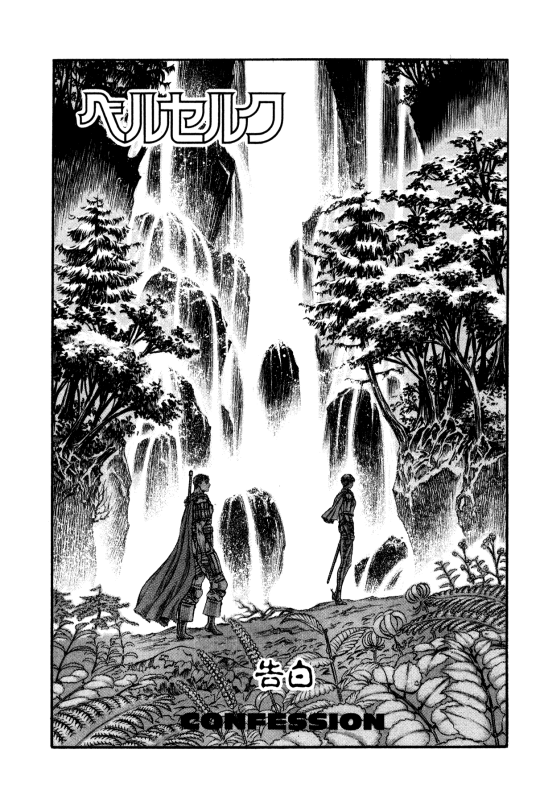
So I want to talk about the waterfall scene in the Golden Age a little.
Okay so first, so why the hell would I be analyzing something like this?
I think this scene says SO MUCH about both Guts’ and Casca’s personality and struggle. More than you maybe think, by just displaying gestures and facial expressions.
(one reason why I love Berserk, by the way)
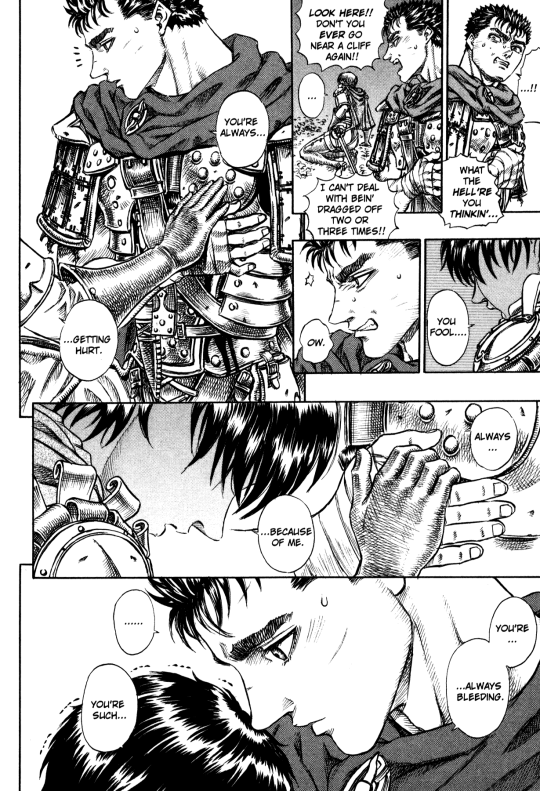
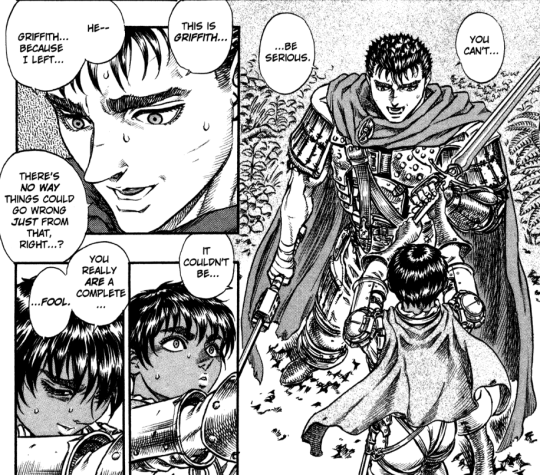
So what happens here is that Casca realizes that Guts obviously cares enough for her to get himself hurt:
Casca is not used to this kind of care.
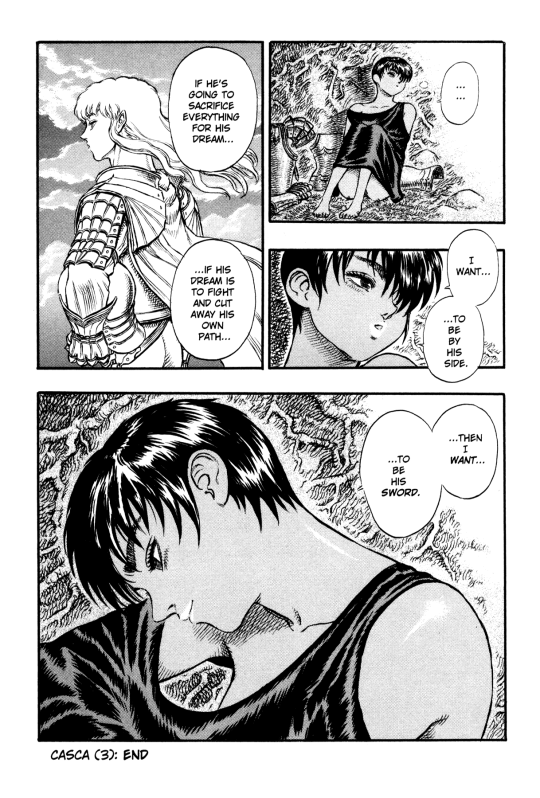
She always wanted Griffith’s praise and acknowledgement, be something important to him. She was always ignored and deprived of it.
And during the waterfall scene (to a degree this also happens during the 100 man slayer scene), Guts shows up and gives her just that; Because he would notwant to get hurt if she didn’t matter to him.
Now, let’s let’s look at it from Guts’ perspective:
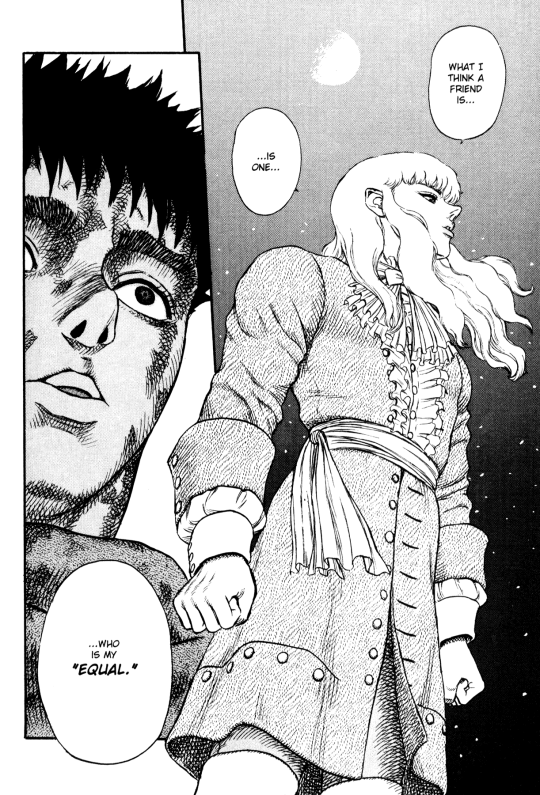
Remember how Guts was always trying to get praise from Gambino? How he always considered Griffith a friend, until that one faithful day when he heard Griffith’s fountain speech?
Guts too always wanted his approval, and hearing that made him feel like a pawn (which eventually pressured him to leave the hawks later on in the first place).
He felt like he did not matter as much to Griffith as he maybe thought, as proven by this page:
In other words: Guts and Casca are literally the same.
I can really relate to both of them honestly.
So what’s going here is both them realizing that they are worthy to matter to someone. They are doing that simultaneously.
Look at Gut’s confused look when Casca suddenly grasps his hand gently.
And as Casca says those words Guts realizes that he in fact also matters a lot to Casca; And Casca is fully aware of what he’s done for her as well.
Up until then, Guts always denied that Casca may even like him, as revealed by the conversation he had with Judeau.
He thought it was impossible for her to like him that much because her place was next to Griffith. Or so he thought.
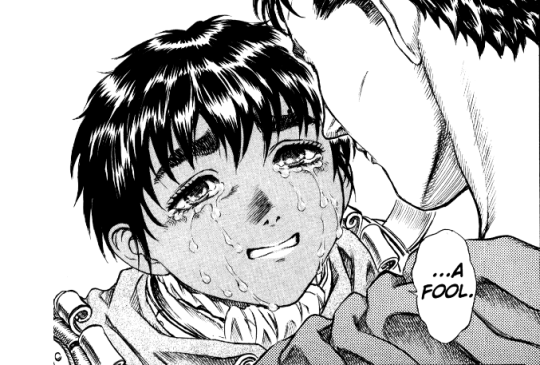
And as Casca tells him he is a fool, I can only imagine what she must have felt: suddenly, after all the deprivation, the stress and the hardship, there is someone who cares, who acknowledges her, who’s trying for her. And releasing these emotions first unleashes strong pain, followed by a healing relief. For the both of them, too.
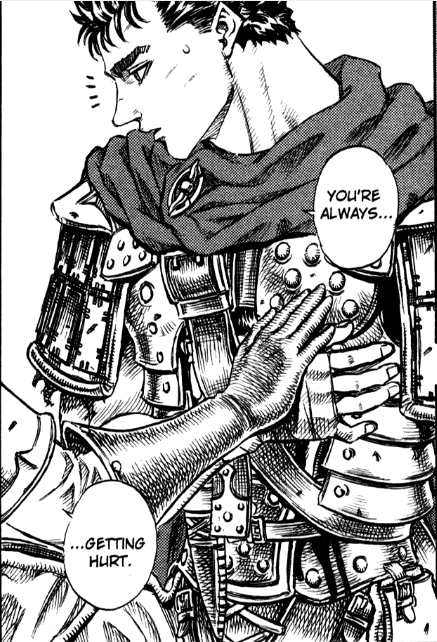
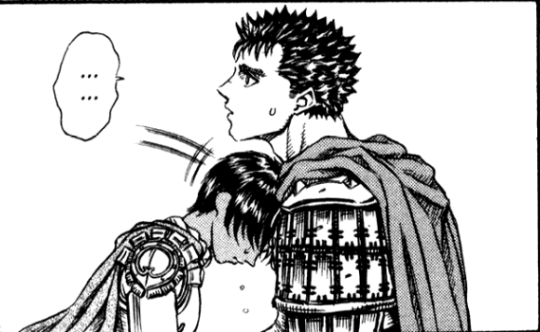
Guts is extremely confused by this. He first doesn’t know what to do. It looks like he’s still processing it, as if asking himself… perhaps:
“Why is she calling me that?” …or “ What makes her say that?” …or perhaps also a “Does she care for me that much?”
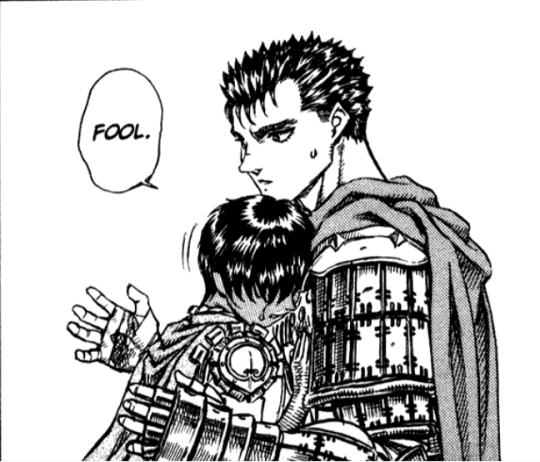
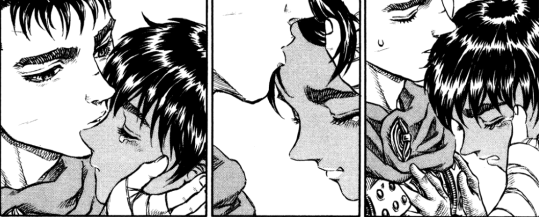
The next best thing that comes to his mind is to what appears to be a return of her hug…
…and also to wipe her tears away.
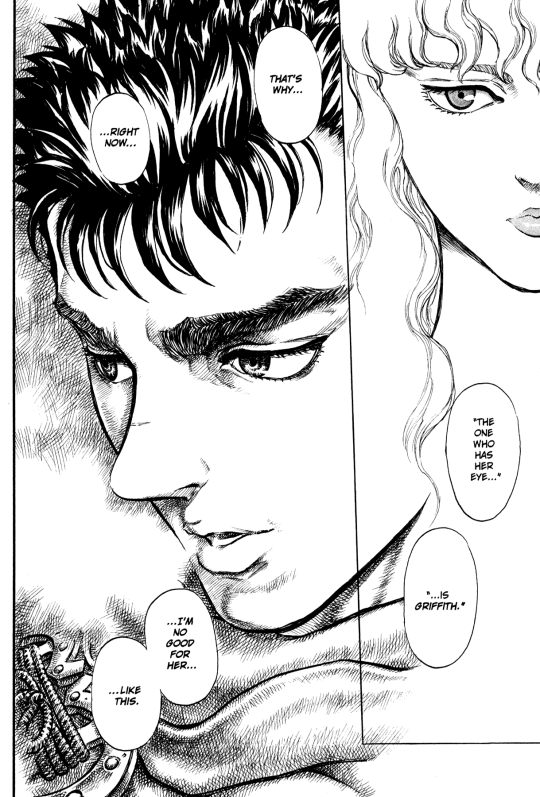
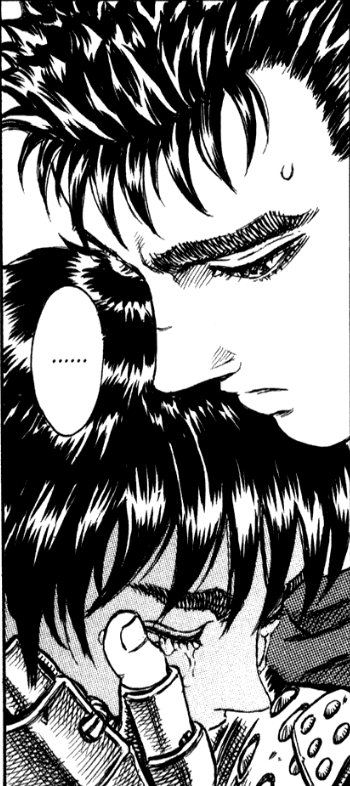
He clearly didn’t like seeing her cry and wanted to give her comfort.
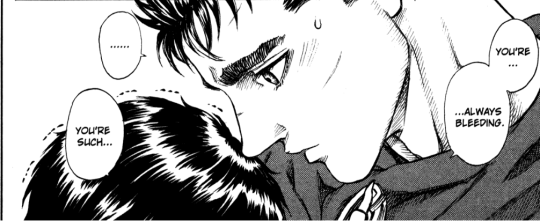
He gets a little more… confident in the next page, starting to kiss her forehead, then literally kissing her tears away.
I hope I do not have to point how damn cute that is, or do I? Imagine the big bulky boi getting all softboi on that vulnerable lil Casca. Oh my lawd.
Casca on the other hand is letting him in, letting him care for her. She seems to enjoy it. I think she really needed someone to be at her side at this point.
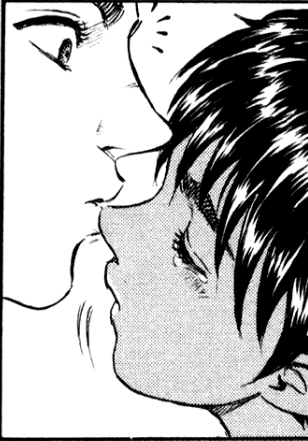
But then, Casca wants a REAL kiss from the guy. Guts face expression is all: “OH GOD NOT SO FAST! This isnt supposed to happen!”
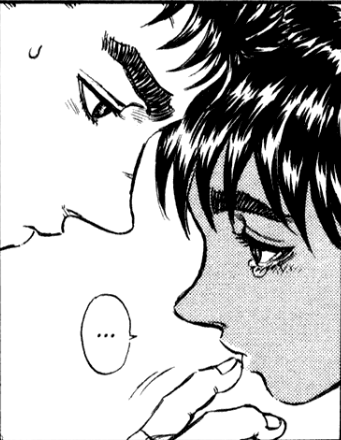
Then in the next panel Casca perhaps has wondered if she went too far. And for Guts, as he is looking at her, it looks like he’s thinking something like,
“So that’show it really is?”
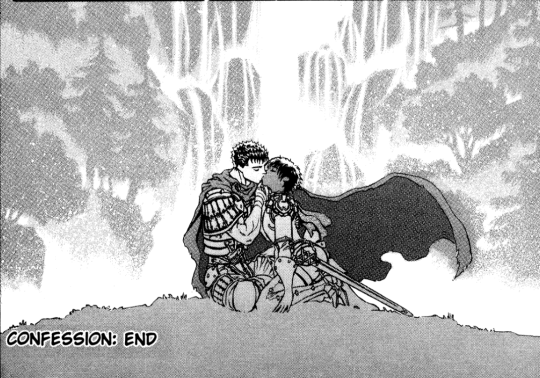
And then of course, the final kiss.
As you can probably tell by the way I have explained this, both struggle with feelings of not being worthy and found comfort in themselves.
They struggle getting closer because they both have been hurt. Seeing them open up to each other with their gentle expressions and gestures is adorable.
What a goddamn tragedy too. Jesus Christ.
Thanks @midnight-in-town for inspiring me to finally make this post happen!
I talked about this, briefly, via an ask on my old account and then immediately deleted it. At the time, I just wasn’t in the mood to bring up and fan what was rapidly becoming a big sore spot for many in the fandom. I disagree with the idea that she’s become a “”reduced”” character for many reasons, but I think one of the major contributing factors to what upset people might just be because in 300+ chapters, some little bits and pieces of Touka’s character might’ve been missed or forgotten.
That being said, I’d be remiss if I didn’t acknowledge that media doesn’t exist in a vacuum and I’m not striving to argue whether or not Touka’s character was treated well as much as I want to talk about her. She’s my favorite character, after all, and the primary reason I got into TG all those years ago.
So call this a Character Study, if you will.
TL;DR: Touka got exactly the ending she was striving for
I’d just like to point out that when we saw Soma jump to the wrong conclusion after Agni was murdered, there were very few people hating on him for it. Yet when Lizzy calls OCiel a liar for actually lying to her for three years, fans are out for her blood.
That’s disappointing.
I added it on other posts and I want to add it to yours too, if you don’t mind. :3 Not only do you make an absolutely valid point, but also… in my opinion we don’t know a single thing about Lizzie’s life for these past months.
Friendly reminder that Lizzie got “what’s supposed to be the truth” from real!Ciel, Bravat and UT and, not only did they kill people to get blood for some experiments, but one is dead and not reliable, another doesn’t even know our!Ciel and UT is totally lost in the idea that bringing back the dead should solve everyone’s problem including our!Ciel’s.
So who can vouch that Lizzie actually knows anything close to the truth about 4 years ago when our!Ciel is the only one who knows the truth and he certainly never mentioned anything?
Our!Ciel and Lizzie just need to honestly talk: she doesn’t side with either twin in full recognition as long as she doesn’t get to know what the real story is (and the real story is that Ciel suffered from survivor’s guilt and didn’t want to disappoint what was left of his family by being the one to come back)
And let me tell you, since Sensei already said that Lizzie was in love with our!Ciel, if anyone thinks that she’s actually going to side with the twin 5ever, you’re in for a plot twist. 😉
There was one important little slice of information on the first page of the most recent chapter that was so casually dropped that it could be easily missed– something I’ve been waiting for for a long time that confirms the overall atmosphere of the Sunlit Garden:
“Tsuneyoshi dotes on him more than any of the other illegitimate children”
I think we can gather from this alone that the children in the Garden were treated well, with affection and care from their father. There was structure and playtime, a beautiful location where individual activities were encouraged (more than one has listen “drawing” as a favorite hobby), and an overall feeling of love. Their childhoods were full of “halcyon days”, as Hairu put it in the light novel, Quest.
Now, to clarify, I want to do my best to convey something about expressing love in Japanese culture that differs somewhat from how many of us understand it in the West. Put simply, people don’t really say “I love you” with the same sort of flexibility that we do in English. There are exceptions of course, but generally speaking, it isn’t something that’s thrown around.
There is a literal translation which you might’ve heard in songs or seen on television before, and that’s aishiteru. You can say the ambiguous suki (“like”) or daisuki (“really like”, which is a little closer), but overall “aishiteru” is something often viewed as pretty friggen dramatic when said in real life. As I’ve heard it put by various Japanese bloggers on the subject, “it something you’d say on your wedding day” or “you’d say it to your grandma on her deathbed”. In certain situations, it can even come off as creepy or stalkerish when said to the wrong person.
I wanted to take the opportunity to introduce this idea, not only in regards to the Garden, but in Tokyo Ghoul as a whole, since I’ve read time and again that “x-person doesn’t really love y-person because they didn’t say it or show it [in a way that’s familiar with my culture]”. That’s understandable, but absurd once you realize that not all cultures express love in the same way.
So, with not explicitly stating “I love you!!” in big neon letters kept in mind, there’s also a social concept in Japan called omoiyari, which translates loosely to having empathy, sympathy, consideration, and understanding towards others. Having a lot of omoiyari is generally a good thing, and showing it is paramount to healthy community. Omoiyari is even more important in your personal relationships, as it’s understood inherently through actions that there’s love between two people or a family, and not simply by expressing it verbally.
We have similar concepts in the West, but it’s something that isn’t as intrinsic or deep-seated in our culture.
***side note, just to reiterate: people do say “I love you” and “I love him/her/they”, it’s just that where’s typically a good deal more weight to it than it does in the West, where we say “I love [ice cream, anime, cats, etc]”. It’s just that the word itself is a little more flexible in English, as it can carry different connotations.
Anyway, the reason I want to talk about this in terms of the Garden is because I’m hesitant to say that Tsuneyoshi didn’t genuinely love the women and children he tended to in the Garden.
I think he did love them. That’s evident in the way that Yoshitoki affectionately behaved towards his father, and it’s evident in the way that Yoshitoki vied for closeness with Matsuri. It was shown through the books Arima picked out to give Haise, and how Haise regularly cooked for the Quinx. These are learned feelings and actions of people who understand love, and who know how to give it.
Tsuneyoshi’s love wasn’t shown on paper through hugs and kisses, but symbolically through images of big bright floral fields and the mention of his “doting” alone.
But! Obviously there were problems that arose from that Tsuneyoshi’s particular brand of love. Arima mentioned that he did express favoritism, and Furuta flippantly suggested that Tsuneyoshi “probably doesn’t even remember my face”, indicating that they grew distant as his actual purpose as a member of V caused a rift.
And that’s where things get really muddy. Tsuneyoshi might’ve loved his kids when they were little, but he isn’t exactly getting Dad of the Year Award. He was running an empire after all, and sometimes you’re just shitty and want to put your pride and power and money ahead of the people you created with the intention to use as tools.
He loves his kids, but will exploit the living fuck out of them for a little cash. Like Toddlers and Tiaras but with more ghouls.
Either way, it makes sense that so many of the kids like Arima, Hairu, and Furuta would find themselves stuck trying to fill the void as adults. As their already-large families continued to grow, and the chasm between themselves and the love that they knew as children became wider and wider, their individual responses of despondence or anger or cries for attention came as absolutely no surprise.
Arima, a bright, thoughtful kid described as “gentle” by the narrator in Quest, became cold and detached as his peers and ghouls alike began to use words like “monster” and “nihilist” to describe him– words he learned to agree with.
Hairu was sweet and well-meaning even in adulthood, but she suffered from a nostalgia that left her longing for the old Arima to return to her, along with all the beautiful memories she had of them in the Garden. Even she misunderstood who he became, and openly admitted to competing against her peers by killing more ghouls for his approval. That was the last thing he wanted, but she died thinking of him nonetheless.
Furuta, a “timid” boy who played with girls and flowers, learned to slap a smile on and deflect his pain with boisterous comedy. He would get attention– good or bad– by any means possible. Love was something he could force with enough torque, and everything became a game as he grew to believe that nothing mattered anyway.
To wrap up, I wouldn’t go as far as saying it was all sunshine and rainbows. Each and every one of the kids were trained with the same barrage as the last. Innocent sparring could have started when they were young, but it was clear that they were subjected to higher and harsher standards as they got older. Furuta’s manic fighting style immediately reminded me of the way Kaiko tormented Yusa, you know? That’s not something someone learns solely on the field.
As a matter of fact, maybe it wasn’t sunshine and rainbows at all. Maybe Tsuneyoshi really didn’t give a fuck. Maybe it was just an illusion of love that strung the kids along and fooled them into working harder for it’s return when the curtain finally fell on their Garden days.
Or maybe it wasn’t so black-and-white.
Even so, in the end, the Garden kids all became people living to make up for what they lost. They wanted someone to praise them, to think about them, and to understand them. They wanted love– some believing they no longer deserved it– and spent their fleeting days trying to feel it for just a little while longer.
Addendum:
I also meant to highlight and underline Arima’s stone-cold truth: that even though Furuta was loved, he was only on the highest rung on the lowest ladder. All of the Garden kids must have been made painfully aware at some point that they were essentially disposable, and that their beautiful memories of the Garden would be tainted forever by the fact that they weren’t worth true and unyielding love in the eyes of the pure Washuu family.
Even if Tsuneyoshi loved the half-human kids, there would always be a barrier that kept it from being good enough.
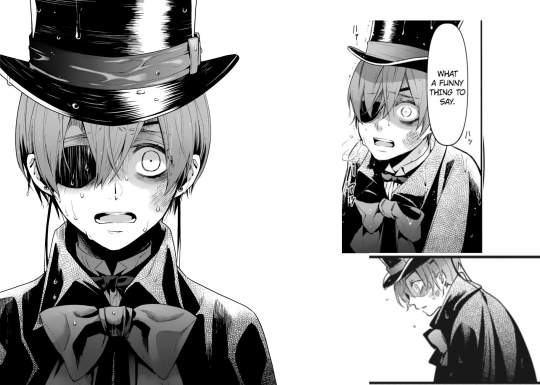
Actually I’m surprised our Ciel hasn’t gotten an asthma attack yet. I mean, this is such a stressful situation for him right now and just look how much he’s shaken and shocked by all this:
And given the situation it’s no wonder our Ciel looks close to a breakdown. He never expected his twin to return. The identity as “Ciel” gave him confidence to return while he blamed himself for his brother’s death. First I even thought what he tried to say in the current chapter here…
…was that he himself was the one who had caused real Ciel’s death. However, given the prior panel…
…you may be right that he had actually wanted to say that it was him who had died that day.
I’m sure our Ciel was always aware of his lie. He didn’t forget who he really was even though he did everything to be “Ciel”. But still, being “Ciel” gave him strength and helped him deal with his feeling of guilt. Now with the return of the twin and with his lies being revealed all this is threatened to be destroyed. And that will surely throw our Ciel into a crisis.
I’m really unsure about where his will all lead to. Our Ciel is certainly forced to face his decisions and the truth now and depending on how he deals with that and on what will happen to the twin he may or may not continue living as “Ciel”. On the one hand it would be nice for him to be able to live as himself once again, realizing that it wasn’t his fault for what happened to real Ciel and that he himself is worth as much as his twin and has all the right to return as himself. On the other hand would it take much character development for that and I don’t think our Ciel is ready to let go of all that he clung to these past four years. Keep being “Ciel” may be the easier way for him.
Touka’s look of despair in this panel makes me come up with several possibilities.
The first one is that Dragon had killed everyone surrounding her but Touka, leaving her in despair because she thought she was about to be swallowed up by this monster just like others too. Given that at this moment she just met Dragon for the first time and could not immediately recognize this is Kaneki, but just another threat for all ghouls, she could be thinking this was her last moment before she died.
The second one, though unlikely, is that she knew this was Kaneki, and was forced to watch him slaughter people in a rage without being able to stop him. I consider this unlikely because Kaneki’s Dragon form right now can hardly make anyone even know it was him except Furuta, but still a possibility nevertheless. If that is the case, this might hit Touka hard because she knew her father had also gone crazy from trying to gain power for revenge, resulting in him being captured and losing his mind just like Kaneki is right now.
The third one is sort of similar to the first one, but instead Kaneki had only killed the CCG squad facing Touka and the remaining ghouls in chapter 143, and the other ghouls were actually in front of Touka instead of behind her back, while she turned her back to temporarily shield them from Dragon, again because she had yet to recognize him. I doubt Kaneki would hurt Touka, the only one he had been looking for while going through this rampage, since his position right now looks more like he is surrounding her to protect her from danger, but the other people’s safety is not guaranteed at all.
Extra note, Kaneki’s human form might actually make an appearance in this chapter too, in the round bubble beside Touka.
This panel looks like an egg to me, and since Kaneki’s story also follows the “Black Goat’s Egg”, in the next chapter we might actually see him emerging from this “egg” he was in to go to Touka. As for how his attitude would be towards everything he had done, I have no concrete assumption to make at all. People speculate him to be absolutely wrecked, devastated by what he had done, but that is Kaneki from part 1 when he accidentally stabbed Banjou and tormented himself over it. But chapter 144 showcased a very clear change in his personality and outlook towards life, when his thoughts were all about eradicating everything in his way including himself and Ishida’s illustration of him wearing the eyepatch on his human eye might represent a disconnection from his humanity.
Nothing is for certain until the next chapter is out or when Kaneki returns to his sense, but oh boy whatever the outcome is would not be pretty at all. And if he had not attacked Touka even when he went berserk and lost his control, then she might be one of the only few people who can talk some sense into him right now.
@freeandfine OMG good point about the eye looking like an egg, I hadn’t noticed!
Hopefully you’re right and someone will be able to talk some sense into Kaneki if he’s coming out of the egg/eye, but tbh, I was considering Yomo instead for this role, since he was warned about how dangerous it was to go where Touka is (:Re ch142) and since he helped Kaneki with coming back to his senses before (even if it might not go so well this time).
On another note, since you mentioned a possible “disconnection from his humanity”, I couldn’t help but notice how this could be yet another parallel with the Berserk series, with Kaneki hatching from his egg…
EDIT: Since I got questions on the subject, let me just add that I’m certain Kaneki won’t hurt her, so I doubt she’s going to parallel Guts or Casca, it’s just a parallel of situation: Touka is pregnant and standing in what seems to be a pool of blood while Kaneki is hatching from an egg, but since Kaneki loves her, it won’t come out the same as during the eclipse in Berserk.
I already talked about this in an ask, but I’ve seen enough misunderstanding about this that I’m going to address this in a full fledged post.
Touka cares about Yoriko. (Yes, she really does.)
Touka didn’t react? Yes, she did react, but in a subtle way. When Touka said “Is it something hard to say?”, she knew that Kaneki wanted to talk about Yoriko’s execution. And then on the following panels on the same page we see this:
Her expression in the first panel is anything but happy. It’s clear that she’s troubled that Yoriko is going to die because of her. And she continued to show that sadness during the conversation, when she was talking about the due date of the baby (but was actually still thinking of Yoriko):
Touka didn’t talk about it with Kaneki? I personally think a lot was said about it during their conversation, though it was through their body language rather than their words. Despite the (relatively) light conversation about the baby and its due date, Kaneki and Touka look sorrowful, and try to comfort each other physically. This is just speculation on my part, but maybe Touka couldn’t bring herself to talk about it without breaking down, or maybe she thought that Kaneki would be more likely to go after Yoriko if she revealed how sad she was for Yoriko.
Either way, even if she didn’t talk about it through her words, both Kaneki and Touka understood each other perfectly. No need for an inner monologue because Ishida showed enough of Touka’s thought process through her actions and Kaneki’s reaction to her decision.
I think one of the reasons this scene was misinterpreted is because of the medium it was written in. It would’ve been much more clear that this was a double-layered conversation if it was animated and fully voiced, because the voice actors would provide the emotions in their voice that a print medium lacks. For example, there was a certain scene in SNK involving Reiner that was confusing for me to understand until it was animated in season 2, with the voice actor clearly expressing the character’s emotions that made his actions much easier to understand.
The manga medium definitely has its weaknesses, particularly in scenes like this. My only advice is to slow down when you’re reading (re-read too!), and pay attention to every panel with an open mind. What are the characters doing, how are they reacting, why are they doing what they are doing? What expression is Touka making, is she happy or sad that Yoriko will die? Why does she seem sad when she’s talking about the baby? How do her actions fit with her character that we’ve seen throughout the entire story?
So this post has ended up with a lot more notes and commentary than I expected so I
thought I would unpack some of my thoughts on the main points that people have brought up. I admit I was a little hasty when I said that Ciel’s
personality was entirely shaped by Sebastian, but I do stand by my point that Sebastian’s
influence is an essential component of his personality. The following analysis is entirely based on my own interpretations so feel free to disagree, I’m obviously not Yana Toboso. However, I did try to provide evidence for the most part to show where I was coming from. So without further ado
here is my altogether far too long analysis on Ciel’s personality.
Vincent’s Influence
A lot of people brought up Vincent’s genetic influence and it’s definitely an important factor to consider. As a key player in the Aristocrats of Evil we know he isn’t exactly Lawful Good. However, I’m not convinced that Ciel was ever directly exposed to the full extent of what it means to be a part of Vincent’s world until after he inherited the earldom. Now here I have to resist the temptation to get into my theories based around 2CT because it’s all circumstantial, but I’m not convinced Vincent would have brought his son into the darker side of his business until he was fully prepared to inherit the earldom, which Ciel clearly wasn’t. I could be entirely wrong here, but everything we’ve seen of Ciel’s childhood doesn’t suggest he had any involvement with the Aristocrats of Evil and I believe Vincent’s influence is purely genetic.
That’s not to say that Ciel’s personality wasn’t influenced by Vincent, some of it absolutely was. Yana Toboso has even directly discussed this issue. Not to mention there was clearly some undesirable character traits running in his mother’s line too. However, I stand by the fact that these traits needed to be drawn out somehow. Trauma absolutely would have played a massive role in this but we cannot forget that Sebastian has made it absolutely transparent that he will kill Ciel if he looses focus and doesn’t follow in his father’s dubious footsteps. So while it is true that Ciel would have inherited the genetic predisposition towards evil, Sebastian was the one who nurtured it and created the Ciel we know.
Another thing to note is that I don’t think Ciel ever learned the way he acts from Vincent. Vincent is shown to be polite, charming, and (if Diedrich is any indicator) he keeps his friends close. Ciel’s habit of being cold and distant to the people close to him is something he learned himself, and Sebastian actively encourages this self-destructive attitude.






 midnight-in-town