So, a lot of people when reading Furuta’s character tend to mitsake what is a deliberate act on his part, for his genuine personality. That Furuta is all the negative traits that he portrays, all the silly traits that he portrays, and therefore a shallow villain filled with nothing but a desire to destroy everything because he sees no meaning in anything.
And at that point you’ve fallen for the mask. Furuta’s identity is splintered, as any character who played so many roles and forced themselves into so many roles would be. People tend to mistake Furuta’s negative traits as stemming from malice, hatred, misogny, misanthropy, a narrative of toxic masculinity, when one of Jungian Psychology applies better to him when you read Furuta as a character deliberately exaggerating the most negative aspects of himself not only to highlight those qualities in his portrayal as a villain but also in the system around him.
he inconsistency in Furuta’s personality, the hypocrisy, it can be read in another way as a deliberate act. A narrative of dissociation and pslintering of his identity, though in Furuta’s case much more deliberate on his part than on Kaneki’s works just as well when reading his character. This is a part of Furuta’s characterization because it connects to Kaneki, it was established with Kaneki before Furuta was even a proper character in the narrative.
Kaneki is a character who seems shy and yet somehow when others have expectations for him, he can suddenly become confident and play the role as expected. Kaneki when interacting with others changes himself to conceal a part of himself, always wearing a mask to cater to their expectations.
The difference lies in the central motive between the two characters, Kaneki wears a mask to get people around him to believe in him and love him, Furuta wears a mask to dehumanize himself because there is a job that he must accomplish that he can’t hesitate, show a sign of weakness, or let his face betray his true intentions because he’s caught in a web of conspiracy. (A literal web because V is symbolized by butterflies, the symbols of life hope and change in Tokyo Ghoul, caught in a web).
The persona, for Swiss psychiatrist Carl Jung, was the social face the individual presented to the world—"a kind of mask, designed on the one hand to make a definite impression upon others, and on the other to conceal the true nature of the individual" [x].
A persona is a mask that changes depending on a situation. The simplest way to explain it is that you would not swear in front of your grandma, even though you normally swear in front of your friends. Personality is a flexible thing and people act differently depending on different situations, or rather they present different parts of themselves.
In video game terms in the persona video games you have twenty four social links based on the arcana, and in each social link you basically cater your answers towards what the other person would like to hear. The answers you give to a relaxing and easygoing character’s social link are different from the answers you would give to a strict and serious character’s social link, which is why the protagonist is silent, they’re a person that everybody can get behind because that person really caters themselves to different situations and wears a different mask depending on the person they are talking to which they thinks will best suit that person.
If it’s easier think of Furuta like a persona protagonist, they have to change themselves based on the situation to get what they want. That’s why it’s important to get the outside context of the situation.
One of Furuta’s first scenes after his introduction, note he plays the role as bait flawelssly and then just as easily switches back to his normal self. Kijima even compliments him “That role is perfect for you” In that he’s a natural distraction.
The first role Furuta plays is a harmless errand boy that nobody pays attention to because he’s always in the shadow of Kijima. Then, when Kijima dies we get a glimpse of his true self.
Notice what the first thing he does. It’s exactly what Okahira asked him to do “Stay behind me.” The moment he gets the order, Furuta twists it ironically on its head by using him as a human shield. Remember in the CCG, there’s a pecking order and a hierarchy. It’s seen as heroic and good for agents to stay behind and die for the rest of their squad. This is how Urie’s father died. Not only that but beforehand Furuta was playing the role of the perfect CCG underling, partnered with an advisor and always following them around and going around with them no matter what they did.
He’s basically Amon to Kureo in part one. Kijima was supposed to mentor him. Yet, Kijima is a crazy person with a chainsaw who unilaterally applies torture to ghouls to get what he wants. He’s bloodthirsty he just only directs it towars ghouls. Yet, we’re supposed to read it as shocking when the guy who always follows Kijima around turns out to be violent as well.
Furuta’s still playing the role of a CCG agent, he’s just turning it on his head. These guys are surprised that the guy who always followed Kijima around is violent, because they tolerated his violence, because the system tolerated his violence and they did not really see themselves as violent. The ending of Furuta the CCG agent, he plays the role perfectly, he shows no empathy for a ghoul, and then he mourns his advisor.
Even when wiping out the rest of the CCG members in the room, Furuta says that they have to report because that’s what a good CCG agent would do. THey have to continue following duty, they’re bound to duty.
Furuta’s masks aren’t just there to be confusing and edgy, they’re purposeful, they’re intentional parodies. Furuta’s role as a ccg agent is the extremes of how ccg agents act, either completely cowed to the violent atmopshere around him to the point of enabling people like Kijima without speaking up, or violent and heartless towards ghouls who are nothing more than man eating monsters so therefore whatever emotions they fight with or whoever they fight to protect does not matter. They’re a critique of the CCG agents he’s pretending to be. How violent was Kureo Mado towards other ghouls, even women and children and how much did Amon just sit there and watch without interrupting or doing anything.
Yet, at the same time a part of Furuta slips out with his masks. You can easily interpret what he says “You can try to cover it up all you want but in the end you’re just a man eating monster” as about the Washuu as well ghouls who pretend to be human, and ghouls with money and influence just like the Tsukiyama. Who pretended to be human and claimed they wanted to be captured and meet their end as humans and yet with a portion of their wealth did things like attending human auctions and covering up Shuu just killing people at random.
This is also a good time to notice that Furuta slicing up parts of his personality and presenting them like masks means there is sometimes a lack of his central personality. It’s important to remember that Furuta was not raised as a human being, he was raised as a child soldier, he was raised for a role from the beginning not a child to be loved so even in his formative years there was not much to give him a personality of an individual person and not a cog in the system. When Furuta’s profile is revealed he seems to be a nobody, no age, no honors, and no hobbies or interests in particular when even a bloodthirsty guy like Kijima likes to tap dance.
Not only does the act of wearing masks wear away at Furuta’s original personality, he also actively suppresses any trace of humanity inside of him so he can better fit the roles. Once again Furuta is caught in the middle of both the Washuu and V’s machinations, if he slips he would have just been erased and killed. He has very heavy pressure not to hesitate, second guess himself, or act as a human would and not a machine that’s bent on destroying the system around him.
I also think Pandora Hearts explained it in a much clearer way with the character Jack Vessalius who parallels Furuta in a lot of ways.
Furuta, continually dehumanized, by the system and then by himself eventually splinters and tries to dissociate his own humanity from himself until all that remains of him is a pile of masks that he stands on, united together by a centralized goal of destroying the Washuu.
The next Furuta we’re introduced to is V Furuta. This is how Furuta is demonstrating that the Washuu and the agents of V act to the audience. The Washuu a patriarchical, heterosexual dominant chain of command that enforces that power structure on the CCG as well.
I mean look how Matsuri acts with Urie.
Or the way Matsuri has to act as family head.
Power, dominance, control with sexuality mixed in as well. Not to mention later on it’s revealed Furuta was raised in a literal rape garden. So there, Furuta is emulating the dominant culture of the Washuu. He spouts their philosophy like he’s nothing more than a loyal follower of the Washuu.
However again a grain of truth is mixed in with Furuta’s dialogue. (Also notice that Furuta often adopts different personas visually when explaining these bits of exposition as if he’s acting them out like an actor on stage. This is genuinely how Furuta believes people will act, they don’t care about the truth, they need to be manipulated, cajoled, they need to be convinced through scapegoats rather than to act on their own.
For the biggest hint that this is all an act Furuta straight up says “You even had to kill your father tsk, tsk, that’s the worst thing to do” and then kills his father 30 chapters later. Loyal V agent Furuta, just a cog in the system, spouts the rhetoric of V, gets off on the tiny amount of power he has working behind the scenes the same way that Kaiko does. Then Eto dregs up a tiny bit of his humanity and look how he acts.
He has an uncontrollable flashback on the level of a PTSD flashback to one of the more human moments of his youth, and a reminder that he was a bred child and then goes actively right back to suppressing his humanity.
Because for Furuta humanity is bad, it makes him lose control and act irrationally.
So one quick detour for Souta the clown, he’s introduced in the Gourmet club the most inhuman of ghoul activities shown in the manga besides the Auction hall, and he acts basically the same way Tsukiyama does. Reveling in his ghoulhood, mentioning how fun others would be to eat, only pretending to be human to string along a target that he wanted to eat, basically the way that all ccg agents think ghouls act that they simply pretend to be human and have human emotions and are heartless killers only concerned about eating.
The clowns specifically as well revel in their roles as outsiders and embrace their monstrosity, claiming that since the world will never sympathize with them there really is no reason to act sympathetic. This is just a brief aside though so I can’t get into the entire clown dogma, but there is a general theme of suppressing your humanity and playing the role.
The world will never love us as much as humans no matter how we pretend to be so why even pretend, why engage at all. This is especially relevant for Furuta who can never be fully ghoul and never be fully human because he was born as a breeding experiment. If he had conformed to the CCG’s desires he would have died as fodder like Hairu, or many of the other nameless V agents, or died young regardless.
Then finally moving on to Kichimura.
The first mask he wears is a party mask, because that’s what they’re doing at these promotion ceremonies, throwing parties to celebrate how many people they killed.
Then in one chapter, Furuta as the chief brings everything to the forefront. The CCG actively recruites from orpahned children. They actively pressure those orpahned children to go into human experimenation such as Shirazu being finanically pressured to accept the Q’s surgery or his sister would die, Mutsuki getting a murder sentence suspended because he would make a good tool for the CCG.
Peace on Death is not even soething Furuta originally said. It was said by Marude, let’s kill all those ghouls and give them peace with death.
The traits which Furuta shows in his performance as Kichimura were all present in all other heads of the CCG. The mission from the beginning had always been mass extermination of ghouls, there’s literally a law that says every ghoul captured must be killed. Amon says multiple times the world is twisted because fo ghouls and he wants to get rid of all ghouls. Urie says that in the first chapter we need to get rid of all ghouls. This is dogma parroted by the CCG over and over again.
Tsuneyoshi and Yoshitoki simply dressed it up, claimed it was just a job, something they had to do. Furuta pushes it to the extreme so people cannot ignore him.
“It’s just a job” for the same reason V agent Furuta parrroted “this is all just to maintain balance, it’s necessary.” The CCG is so blind that literally when Juuzou says “I’ll massacre everyone on the bridge” somehow one member of Juuzou squad says “they’ve managed to make us feel like murderers.”
Then finally, the conversation in 101. Why does Furuta act the way he does in front of Kaneki. So, the first thing Kaneki does is after establishing himself as Furuta’s opponent say “I wanted to talk with the Washuu.”
Furuta even says this. “I had the clowns do a bit of acting.” he’s already staging the role. He’s scoping things out with Kaneki, Kaneki to be his hero and Furuta to be the villain everybody unites to defeat.
So, if Furuta wanted the same thing as Kaneki, the destruction of the Washuu, coexistence, why didn’t he just state it? Why did he antagonize Kaneki on purpose? And the answer is quite simple.
“I wanted to talk to the Washuu.” imagine you’ve been planning your whole life to overthrow the evil family that bred you, raised you as a child soldier, and having to betray and stomp over others all this time to get this far and secure this one opening and you’ve finally killed the family that’s oppressed you your whole life.
THen the person whose been chosen to lead the violent ghoul revolution that definitely needs a plan to improve the world goes. “Oh I was just going to talk to them.” like he’s just winging it. He’s scoping out Kaneki, and he realizes right away Kaneki’s not serious about this. So, Furuta defaults to what he believes, that people will not act unless they’re cajoled into it, that they need narratives to act, that they need to be manipulated with stories, stage trickery, and spot lights rather than being convinced to care through empathy. He basically tells Kaneki what he’s going to do, create a great enemy for everybody to unite and fight behind and that it’s all scripted beforehand. They’re all playing roles.
Then, Kankeki during his scoping out reveals his real reason for doing this. It’s about him, not about destroying the Washuu, hence why he has no real plan.
Then, Furuta explains that he’s a bred child soldier that he was going to fight all of his life in servitude under the Washuu until he died a useless pawn and Kaneki still doens’t get why he might want to overthrow the Washuu. So, Furuta puts on the mask he’s expected to in this scene.
‘I DON’T CARE I’M DOING IT FOR THE LULZZZZZ” because Kaneki doesn’t even want to try to see what Furuta’s motivation might possibly be. He can’t put together that a child soldier might want to free himself from a system that created him.
Furuta reveals one small part of his humanity, that when he was a child there was somebody he had a connection to, that he cared about.
Then, immediately the mask comes back on. LOL NO ACTUALLY I’M A CREEP. I JUST WANT TO MARRY RIZE THERE’S NO MORE COMPLICATED REASON THAN THAT.
Furuta knows his actions towards Rize were monstrous. He did it to sever away that human portion of himself, to become the mask, to not care about anything and prove that he’s a monster and every time he slips and pretends to have actually been a human at one point in time he reasserts that he’s a monster even harder, he doubles down on the act and exaggerates the worst parts of himself because that’s how he sees himself too. He wants to become the mask, because Furuta the scared garden child who did one good deed can’t possibly bring the whole system down.
Furuta says in his most honest moment. I decided I’d destroy everything, his whole life devoted to that goal, and thus he had to do terrible things, fit himself into roles without ever giving away his true motivation, all to accomplish that.
So if Furuta acts inconsistent, acts inhuman, it’s on purpose, it’s a mechanism to deny his own humanity and better fit the role he’s playing by necessity in order to accomplish his goal,
So, this post is a really long time in the making. A lot of my recent hiatus has been fine tuning my thoughts for this post. Consider this my final meta for Tokyo Ghoul if you would. This is something I’ve wanted to write about for awhile, because the vast majority of the fandom seems to be a misconception among the fandom about Furuta and Kaneki’s foiling, that Kaneki in fact has nothing in common with Furuta and is a hero to his villain. That the only shared aspect between them is loneliness and that Furuta is just an example of what Kaneki would be without loved ones around him.
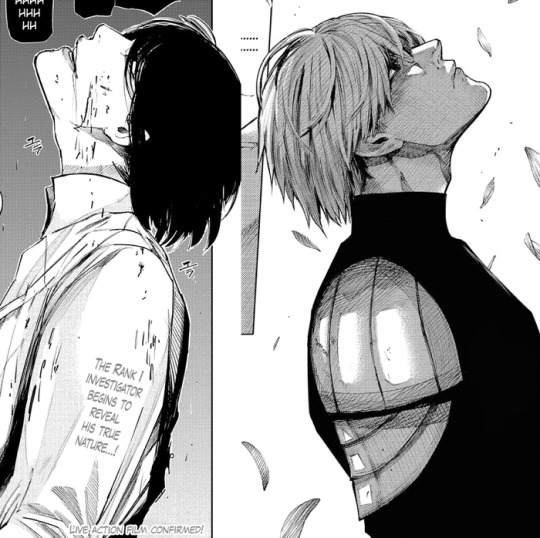
However, as the 101 title page suggests the characters are actually deeply connected and intertwined to the point that when they become too close it can be difficult to tell where one ends and the other begins. All of Kaneki’s unhealthy habits, perceptions, flaws are mirrored in Furuta, but in Furuta’s case they are framed and made much more clear. It’s only by acknowledging how much Kaneki and Furuta are alike you can see the whole of Kaneki’s character, the good and the bad. With a close and analytical reading you can pick out all these connections which is what I’m going to do below.
The thrilling saga of my “why TG is not ending yet” theories continues as I try to prove why this is not a matter of Ishida rushing his story to a premature end and he has actually planned to end :re at chapter 179 for a long time as well as to have the resolution arc as a separate entity. There seems to be a common theme in these latest chapters that supports this.
These current events parallel the end of part 1 in several ways, we for example have Ui, Juuzou, Hirako and rest of the gang battling the Owl
Kaneki going off on his own underground, because he’s tired of not being able to do anything
On the way a friend of his sacrifices themselves so that Kaneki can keep going forward and they go missing in the process
And he in a big underground area meets Arima and Furuta who he has to get past by using force. If Arima technically was the main villain of part 1, Furuta was that for :re, they are the obstacle Kaneki is meant to get past.
The main difference here is that while in part 1 Kaneki decided to die and succumbed to his flaws, here he is doing his best to live and move forward. Kaneki actually managed to learn this lesson and won thanks to it, his change in attitude highlighted by his discussion with Furuta. Kaneki never got past V14, but here he finally took one step closer to his goal and this is where the parallels end and he gets a happy ending, right?
There is a twist however, because Kaneki despite his pretty speeches about living has not yet reached the complete end of his journey and is instead still in the middle of Judgement, not the World. The biblical symbolism present is referencing the Book of Revelation, which happens to have an event called the Final Judgement. Also, in two poems Ishida has written in the past, the theme of judgement is present and those poems seem to match the current events rather than anything that has happened before. Judgement seems to be a recurring theme, which is important, because it is not the ending point of the journey, those V14 parallels I talked about just now will be relevant too.
Before anything else though, I’ll just roughly go through some of the Book of Revelation symbolism in the One Eyed King and Dragon arcs to get this started
In the beginning a scroll with 7 seals is presented to the Throne of God and it is declared that only the Lion of Judah, the Lamb, is worthy to open it. The Lamb was given praise and angels along with creatures from Heaven and Earth fell down before him.
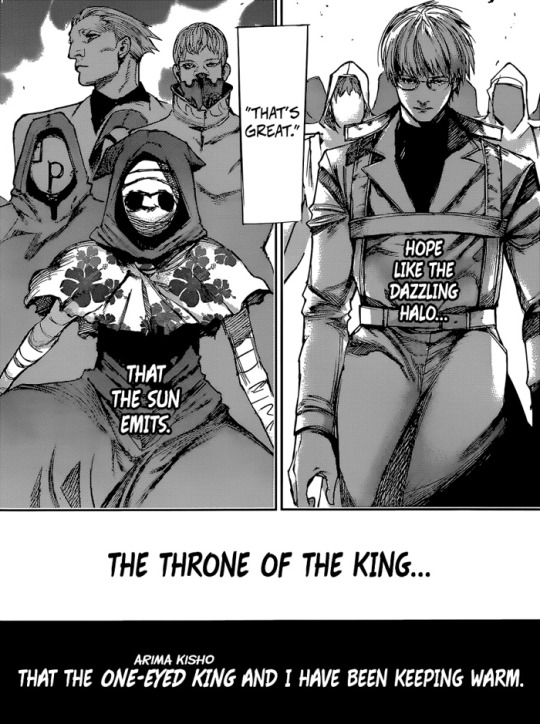
I believe the Lamb in question is Kaneki who was given the role of the One Eyed King by Arima and Eto who represent God.
Both Arima and Eto are like gods in the series, Arima even has the nickname God of Death and is seen as one by the CCG and ghouls
Eto especially has a lot of biblical symbolism associated with her, for example the instance of her talking about Genesis with Karren and wanting to become her god. If Arima is the one who ultimately made Kaneki become the One Eyed King during Cochlea arc, Eto did most of her part of the job back in Tsukiyama Extermination arc by awakening his memories using Karren. The biblical symbolism with Karren and Eto becoming her god is what she tried to do to Kaneki as well
Both Arima and Eto were basically in the position of a God for Kaneki, Kaneki even was like a son to Arima (plus Eto wanted Kaneki to become her child) and has some Jesus symbolism associated with him. For instance him being stuck in the Dragon and being in coma lasted pretty much exactly three days before he woke up and was reunited with his loved ones.
Kaneki is also associated with goats a lot, with the book Black Goat’s Egg and the fact that he even named his organization Goat after becoming the One Eyed King, therefore it’s fitting that he is also the Lamb.
His role as the One Eyed King can be considered the scroll since once all of the 7 seals are opened, the Apocalypse begins, just like how Kaneki’s time as the One Eyed King only led to ruin, destruction and loss of lives. Even if Kaneki technically failed as a King, the outcome still happens to fit with Eto and Arima’s ideas of what the world will look like in the future. For Arima:
And Eto’s world that is yet to come
It is just around the corner though since once the Apocalypse is over, the old Earth and Heaven are replaced and there’s a new order of things in the world. What the story is heading towards is in fact quite literally a factory reset, but I’ll get to that more in detail later. What matters is that when Kaneki was given the scroll, it led to what it was supposed to lead to, the Apocalypse.
The six seals of the scrolls are undone and there was a great earthquake, the sun became black, every mountain, island were moved out of their places etc. Mankind hides from the one who sits on the throne and the wrath of the Lamb. The seventh seal is then broken, followed by half an hour of silence and destruction that devastates the Earth.
Typical apocalyptic events occur and this is represented in the story. The way the borders of the pages became black during Kaneki’s time as the Dragon might represent the sun becoming black, mountains and islands being moved out of their places is the same as all the buildings being devastated and there was an earthquake as Kaneki became the Dragon. Most notable one is chapter 145, which has no dialogue as it most likely represents the silence. Once the seventh seal is broken, numerous different kinds of devastating events occur that kill a huge chunk of humanity, but one particular thing Ishida seems to reference a lot is the bottomless pit.
As the star opens the bottomless pit, smoke rises from the Abyss like smoke from a gigantic furnace darkening the sun and the air. From the smoke locusts come out who are commanded not to harm anyone or anything except for people who were not given the “seal of God” on their foreheads. Locusts were commanded by the Abaddon, the angel of the Abyss who many interpret to be Satan himself.
This is a reference to the oviduct that houses Rize in the 19th ward since the place where she’s situated at is told to be a huge cave that seems pretty bottomless as Kaneki peers down it.
Furuta also has the key to the place where she resides before being interrupted by Kaneki. The bottomless pit is actually the place closest to Hell and Underworld where the Dragon is eventually banished to for 1000 years.This works since the Dragon present in the Book of Revelation is actually Rize rather Kaneki since he was just a tool Furuta used to turn Rize into her current form
Rize also represents Satan who commands the locusts as she is the one creating them and has St. Peter’s cross on her forehead. The Dragon in general is meant to represent Satan/Devil in the Book of Revelation.
The smoke rising from the pit is the poison that infects people with ROS and blackens the sky and the locusts are the kagune monsters that attack everyone and spread the disease in the process.
Since Rize is the true Dragon, Kaneki and his Dragon form represents the Beast emerging from the sea.
The sea being the sea of corpses from Kaneki’s mind where all the people he killed during his rampage went, the place by the Torii gates in his mind where he talked with Rize
It’s also noted that the Beast has a fatal wound, which they had miraculously healed, Kaneki too managed to heal his grave wounds and stop his aging by becoming the Beast.
There is also a second beast that emerges from the Earth known as the False Prophet. He exercises authority on the previous beast’s behalf and caused miraculous signs that cause people to follow the Beast. He is also connected to the Dragon.
The False Prophet is Furuta since while in the Book Revelation they would be the two Beasts, in TG they are the two kings that are very similar to each other. Kaneki’s Dragon form was also technically Furuta’s ally and it was what he called it himself too. People worshiping the Beasts was seen soon after Itori, who was working with Furuta, tried to manipulate the people from Goat.
While it wasn’t during the actual Apocalypse, we also saw the huge cult like following Kaneki had as well as the fact that Furuta himself was quite popular himself and even had a fan club.
The Beasts were good at making people follow them and worship them. There are probably some other references too, but these are just some of the bigger ones I noticed. What this all seems to be leading up to is the highlight and climax of the Book of Revelation, the Final Judgement.
Jesus finally returns to Earth, which the Beast and False Prophet try to fight with armies of their own before they are defeated. The Beast and the False Prophet are cast into the lake of fire while the Dragon is imprisoned in the bottomless pit for 1000 years. The Dragon is freed after 1000 years, tries to deceive all nations in four corners of the Earth and gathers people to fight the God, but is eventually defeated and cast into the lake of fire as well. The wicked dead and all of those who died during the thousand-year reign of Jesus are resurrected and judged. A new Heaven and new Earth replace the old ones and there is no more death or suffering as the old order of things has passed away.
Kaneki’s Dragon form, the Beast, has been defeated and while he was stuck there, he technically was working with Furuta, the False Prophet. And like I explained before, Kaneki has Jesus symbolism associated with him so he also takes the role of the one who fights and defeats the False Prophet, leading to both of the Beasts being taken down in the end. Rize the Dragon meanwhile is imprisoned in the bottomless pit, which was where all the smoke and locusts previously came from. Kaneki now has been imprisoned in the bottomless pit with Rize and is going to be stuck there for some time, which is going to represent the 1000 years of peace before he comes out with Rize and a new conflict arises. Kaneki caused the Dragon to be stopped so he as the Jesus is the one who allowed this period of peace to exist, which of course is followed by the Final Judgement after those 1000 years of imprisonment.
Kaneki also seems to take the role of archangel Gabriel, who resurrects the dead in the Judgement tarot card and is one of the angels that causes the Apocalypse to happen.
His appearance is like that of an angel with wings and crosses with a white color scheme. Chapter 164, where he gets his angelic appearance, is even called “The White One”. Archangel Gabriel blowing his horn on the Judgement tarot card is the thing that makes the dead rise from their graves and in the Book of Revelation a trumpet blast is said to proceed the resurrection of the dead. On the card is depicted a sea where caskets float and this sea of corpses is a recurring motif with Kaneki. There has been plenty of foreshadowing and teasing in the story about bringing back the dead, but we have yet to see any kind of payoff for it. Furuta mentions this being possible, but the Beast, Kaneki’s Dragon form, of course is not capable of doing it.
As the dead are resurrected, the old Heaven and Earth are replaced and like I mentioned before, it is essentially a factory reset. The factory reset that Eto wanted to see and who coincidentally happens to have returned just a few chapters ago even if that would be kind of pointless if there’s nothing left for her character to do in these final chapters. Arima is back too in a way, in spirit at least, during CCG’s fight with the Owl (Oh, and Hairu, the prime candidate to be resurrected is there too)
The Judgement symbolism carries over to Kaneki’s personal character development as well since with Fool’s Journey he is not at the World yet despite all his revelations, he is still at the Judgement.
The Judgement card calls for a period of reflection and self-evaluation. Through meditation or quiet reflection, you may come to a point of deep understanding about the common themes throughout your life and what you can do or change to avoid these situations in the future.
The Judgement card suggests that you have reviewed and evaluated your past experiences and have learned from them. All the pieces of the puzzle of your life are finally coming together to form one, integrated picture of your life story. This integration has healed any deep wounds and you are now in a position to put the past behind you. Your memories no longer haunt you, and you are able to understand and value what has happened to you and what it has taught you about life.
This is exactly what Kaneki talks to Furuta about, he has had his moment of self reflection and found peace with has past and where he is right now. He has had time to think about things and learn from his old mistakes, the past is no longer something that hurt him, but it is something that turned him into the person he is and gave him everything he has. He is completely content with it.
Judgement is about finding absolution. Through a period of self-evaluation, you will feel cleansed of your ‘sins’, wrongdoings and mistakes, and you will finally be released of your guilt and sorrow about the past.
Kaneki also acknowledges the fact that everybody in this world hurts each other and finds absolution. Kaneki committed a grave sin by becoming the Dragon and killing half of Tokyo, but he doesn’t get stuck on it and moves forward, he is at peace with everything that happened
You may even feel a calling – a personal conviction of what you are meant to do. If you are in a low period, in need of hope and absolution, Judgement can show you that renewal is at hand.
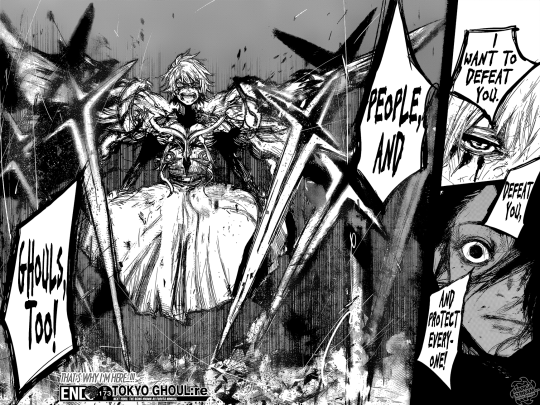
That doesn’t mean Kaneki is going to ignore all his wrongdoings and instead of just feeling guilty, he decides to take responsibility for his actions. This is Kaneki’s resolve to do something for the sake of people around him, him being tired of not being able to do anything and that resolve is not shaken even by Furuta as he moves forward towards his goal.
The angel on the Judgement card also represents the Fool’s higher self calling them to rise up and fulfill their promise so Kaneki doesn’t just physically represent the angel in question.
You may be at a crossroads, aware that any decision that you make will bring about significant change. The choice can be an obvious one, or perhaps the only viable one. You know that this choice must be made and you are facing it with maturity and level-headedness.
He is making his choice despite being hesitant to kill Rize, because he believes this is what must be done to save everyone, even if it has its downsides
Kaneki is at Judgement, but he has not reached the finish line yet. The World card is about reentering the world with a complete understanding and Kaneki at the moment is basically stuck in the Underworld and has to get out. The moment Kaneki emerges from the pit is the moment he has reached the World and is the moment he has to become more involved with the world around him. Kaneki is going through his trial of Judgement, but the end is not that near yet.
This finally gets us to the poems that Ishida has written that are pretty much about this event and these latest chapters. You can read it fully here.
Interesting thing to note is that poem is divided into three sections. I’ve already talked enough about how the announcement about TG:re ending was handled in an extremely unusual way so I won’t get into that now, but one of those strange things was the three chapter countdown we got so suddenly. My theory is that the three chapter countdown for the climax of the story is meant to represent the Final Judgement and each of these sections describes one of the chapters. The first section should represent chapter 177 and is from Kaneki’s point of view.
(1)
The end of the trial
All lies are being revealed.
All sins are being judged.
A reference to the Final Judgement and Judgement phase of the Fool’s Journey. Facing Rize is the end of the trial for Kaneki and Furuta was what started it.
The first thing that disappoints you is anger,
and if you’re sick of being mad, then it will try to kill you.
This bit is rather vague, but it seems to fit with Kaneki’s feelings toward the world and Rize. He is no longer mad at the world, but currently it and Rize too is trying to hurt him
A god that is willing to murder for atonement,
is no different than you people.
Kaneki is being put into the position of Jesus or an angel and is doing all this to take responsibility for his actions. Ultimately he is put into a situation where has to kill Rize to atone for his actions and in this chapter he even talks about how he is not special compared to everyone else.
Next is a single leaf from a fig tree
that conceals a body without leaving a trace.
It carries through while it is still vivid.
In Garden, Adam and Eve covered their private parts with fig leaves after eating the forbidden apple and becoming ashamed of the fact that they were naked. Before that they were free of sin, but this event changed everything and when they were banished from the Garden. This is probably a reference to Rize who escaped from the Garden and started living irresponsibly and “in sin” until she was captured and ended up in the fate she currently is in.
As blood spills in that moment, you softly laugh.
Blood spills as Kaneki attacks Rize
(2)
The ark is being swayed like a casket.
V called the Dragon their Ark
It is swaying like a casket since both Kaneki and Ayato got trapped inside as it collapses and the V agents too are finally defeated and this is the end of their journey, the Ark only led to V’s doom
“It’s okay if a cute person catches your eye!”
And then I went blind.
God is resentful because of his lost eyesight.
This is a reference to Kaneki’s first meeting with Rize. He at first regretted catching Rize’s eye, but in chapter 176 came to terms with it and thought it was a good thing since it helped him meet all the important people in his life.
It is in quotes though. Not only did Rize catch Kaneki’s eye, but Kaneki also caught Rize’s eye
And she went blind thanks to it as it was what led to her capture by Furuta and her current cruel fate. The one who feels resentment about the event is Rize
Because of your self-righteousness,
how many have had their blood spilled,
how many have suffocated in the depths of the sea?
Reference to Kaneki’s flaws what eventually caused him to fail and kill half of Tokyo and also perhaps a reference to events even before that where Kaneki caused the death of lots of people due to his flaws. This also happens to be a something Rize and Furuta to an extent share with him
It is what Rize called Kaneki out on at the Torii gates, but as Kaneki tried to move forward, Rize stayed behind
The buildings are gravestones floating in the sea.
And as they creak, the crooked foundation
one day breaks with a quick snap.
If Tokyo is the sea where all the people Kaneki killed died, the buildings that were wrecked by his Dragon form in the process are the gravestones along with all the other oviducts, including the one Kaneki and Rize are in right now. It too breaks with a quick snap in this latest chapter
That is when you experience the dull figures with your eyes.
That is when you stack up the limbs of someone you love.
That is when you get tired and fall asleep.
It happens, so abruptly.
Submerging beneath the sea again.
Kaneki falls asleep inside the Dragon and submerges beneath the sea once again, this time unable to escape.
Stacking up the limbs of someone you love could refer to Ayato since Kaneki was trying to look for him before he got stuck inside the Dragon or it could be referring something yet to come since it is talked about later in the poem.
People are bound to lose.
Our gradual burial at sea.
Everyone I know has died,
and I cry to the point of dying.
Before long, everyone became a pillar of salt
and it too, dissolved into the sea.
(3)
If the world ends for someone I know, then that’s okay.
The cradle swayed and disintegrated.
The sea filled up with salt and dried out.
A throat is punched with holes, and all the blood began to sing.
You will no longer be able to stop laughing.
When the world ends, the last person alive will truly think he is a villain.
It has been pointed out several times during these last chapters that everyone will eventually die
Kaneki however was not bothered by it as he said he was going to always strive forward.
This time it seems like he was the one to “die” while everybody else lives, a repeat of V14 despite the poem suggesting there being an inversion of Kaneki surviving while everyone else dies.
I already mentioned how Kaneki is connected to the resurrection of the dead when I talked about him being Gabriel of the Judgement tarot card and this is how it might happen. Furuta already talked about how the old Nagaraj shared some of his life force even if he probably killed more people than he gave life to.
After, which he turned into stone.
Perhaps the stone in question represents the salt pillars in the poem, the act of taking and giving life goes with the all of Judgement symbolism too. Kaneki eventually is going to be the key to resurrections according to all the symbolism I already talked about so perhaps now that Kaneki is separated from everyone else, he feels like he’s the only one left on Earth, feels like everybody he loves is dead. The V14 parallels I talked about still apply since this is the exact same thing that gave Kaneki amnesia. After his confrontation with Arima, he was stuck in a jail cell and wanted to reunite with everyone before being made to believe that they were all dead.
Now too after his confrontation with Furuta, he ended up being imprisoned again separated from all his loved ones, just like now he is meant to stay away from them for “1000 years” before the Final Judgement can occur. After all a total destruction is needed until the Earth and Heavens can be reborn and it was said that those with Washuu kagune have the power to change the world, this being Rize and Kaneki’s kagune too
Maybe Furuta was right that it was all will be in vain, or maybe it’s just a brief obstacle to be overcome. The world being reborn would be a valid reason for Ishida to separate the final resolution into its own part rather than include it with :re, it would also give it the same feel as Part 1 had when it ended. I’ve also before talked about why it would be a valid reason to divide TG into three acts, the third one happening right after the climax.
There’s also another poem that Ishida released, the Phosphenes poem found here: (x) The art that came with it is interesting in particular, because the number in the corner is almost the same as 179, the supposed final chapter that I believe will be about Kaneki and Rize
If behaving like a god is a sin, even the act of creating life would be blasphemous. Wouldn’t doing this be mocking the gods?
The act of creating life is brought up again and as I previously pointed out, whatever Kaneki now does underground might lead to resurrections, creation of life that even Furuta talked about. The poem seems to be implying though that something even worse than creating life is being done.
Wanting to be judged, I entered the prison of my own free will. I play around with sludge in a silent room. “So you’ve come back again,” I was being cursed at with a timberless voice.
That place was dazzlingly beautiful.
Again, Kaneki entering the bottomless pit to meet Rize can be considered his final rite of Judgement and that quote probably belongs to Rize as she meets Kaneki again after he left him at the Torii gates. Kaneki drowned in the sea like she hoped he would and they’re now reunited.
The area formed from kagune is sludgy, but yet so beautiful as Rize herself looks like a godly being. It’s important to note that this meeting with Rize is the climax of his Judgement, the end of the trial as the previous poem said. Kaneki moved to Judgement after his meeting with Rize at the Torii gates and now he’s reunited with her at the sea of corpses and being tested to see if he can truly move on and reach the World, end of his journey.
I was starving to death, and then from when I was gnawing on someone’s body, that’s right, from that moment, it all became strange. There definitely have must have been poison in there. Only beautiful merely to the eye, and shit.
This reminds me of the myth of Persephone who was abducted to the Underworld (coincidentally this bottomless pit where Rize and Kaneki are right now is also near the Underworld/Hell) and ate some pomegranate seeds that forced her to stay there during winter months since she had eaten the food of the Underworld. Chapter 162 happened to be called “Holding a Pomegranate” and it was the chapter where Kaneki woke up after returning from the Torii gates where Rize is. The reverse happening now is fitting, especially now that the latest chapter talked about the poison Rize emitted.
There’s a spider lily too, an ominous flower that typically bloom in graveyards and is associated with death. They grow in Hell and guide the dead to their next reincarnation. They specifically symbolize lost memory, abandonment and never meeting someone again.
I don’t want to put anything in my mouth, I don’t want to hear anything. I don’t want to see anything, anything at all.
The three wise monkeys are related to the sins we’ve committed and therefore fits with the theme of Judgement.
Place myself on a scale, along with the things being sold off, along with the ripped-apart bodies given away in pieces, along with playing by peeling off scabs, don’t, don’t.
Throw away everything you don’t need out the window. It’s okay if you fall and die. Until the very end, lend your ears to just the sounds fading away.
Once again this seems to be related to the previous poem and Kaneki losing people that matter to him and being left alone, the scale line in particular reminds me of chapter 140 of part 1.
This was the last moment of self reflction for Kaneki before his end and with all the V14 parallels we will probably get this too since the inner monologue in chapter 177 was instead more meant to be a reference to Yoshimura’s words (x) I suspect the next and last chapter will be exclusively in Kaneki’s head, because of this and also because of the parallels to events 100 chapters ago. Latest chapters have all had a reference to something exactly 100 chapters ago, between 76 and 176 there was this moment with similar paneling and theme about living
In chapter 77 we had Urie venturing and finding Torso, in chapter 177 we have Kaneki venturing underground while and finding Rize, both struggling on the way
In chapter 78 we have Torso explaining his backstory and Mutsuki becoming sympathetic towards him despite all the awful things he’s done to them. Chapter ends with Mutsuki potentially about to meet their end in the hands of Torso after having been captured by them for a while
In chapter 177 we have Kaneki feeling bad about killing Rize since he was always sympathetic towards her despite her originally trying to kill him and starting his tragedy, now Rize traps Kaneki and potentially is about to get him killed. The reason I mention this is, because chapter 79 is exclusively about Mutsuki, them being stuck inside their own head and realizing new things about themselves. A moment of self reflection and discovery just like what Kaneki went through in V14. Chapter ends on Mutsuki discovering something awful they’ve done while they were spaced out and start laughing like a maniac.
Sounds similar to the end of the last poem, doesn’t it?
A throat is punched with holes, and all the blood began to sing.
You will no longer be able to stop laughing.
When the world ends, the last person alive will truly think he is a villain.
This Phosphenes poem though finishes with this:
Hey, how many things did you get that you wanted?
Kaneki in the end found all the things he wanted, but…
…the field is filled with our old friends, red spider lilies.
We are once again going through a period of transition, Kaneki has “died” and his loved ones are left waiting. The manga will end, but soon a new part will be made that continues after a time skip. A new manga for a new world, which is fitting since this references the Book of Revelation. There will be “1000 years” of peace before the bottomless pit is opened and out comes the Dragon with Kaneki and a new conflict arises. It won’t last long though since it is easily stopped and soon after all the dead are resurrected and their sins are judged. This is what part 3 will be about and once Kaneki comes back, he’ll have completed his trial of Judgement and reach the end of his character arc. In the end the Judgement always leads to the World, which in both the Book of Revelation and the Fool’s Journey is a happy ending.
I suppose it’s about time for my take on the most recent fandom crisis.
To me, it seems that Rize died for the same reason Furuta did. Both indulged in escapism instead of processing their pain, both created tragedy instead of fighting against it, and most importantly, neither took responsibility for their sins and tried to make things right. They never ceased to be driven by selfish desire, even if it was at the cost of everyone else.
Though sympathetic characters, it was this unrepentant irresponsibility that led to their destruction, not because they deserved it, but because giving into tragedy will only ensure it.
You know, I don’t agree that Furuta died because he giving into tragedy. That he didn’t fight against it. If he hadn’t fought against his fate, he would have just lived his 25-30 years and died as a nameless instrument of Washuu family. The decision to destroy everything is his fight against tragedy. And I believe this is quite a logical decision for him. He didn’t commit inconsistent destruction. He had a plan. All this had a certain purpose. So what is it if not a fight against his own tragedy?
Ah, but Kaneki fixed his lifespan, it seems. Arima did not die as a nameless instrument of the Washuu family; he contributed directly to the downfall of systemic tragedy.
When I say “fight against tragedy” I do not mean “act in response to your tragedy”, because that can apply to anyone. The point is the will to create a better, non-tragic world, where people cease to suffer so terribly as a whole rather than simply making oneself the oppressor to avoid suffering yourself. Furuta merely wanted to make things worse, more tragic, destroying everything and maximising oppression with himself at the reins. That is a reshuffling of the systemic tragedy, not a dismantling of it.
He does all this because he does not believe, due to the inevitability of death, that a better world is possible, so he wants to be something more than an insect crushed under the heel of the system. However in playing by the rules of this tragic game, by preserving it even if reshuffling it, he is no more free of tragedy than he ever was. He cannot destroy it while he creates it, so while Furuta indeed fought, he was fighting in the opposite direction to what he should have. This is why I say he gives into tragedy – because he accepts its narrative and, unable to deal with his pain, reproduces it.
This is in contrast to Kaneki who wants to dismantle this tragic world and create a peaceful one for everyone.
Take this analogy: Furuta is a man who, upon hearing that his town will be invaded by an overwhelming enemy army, believes victory impossible. So he decides to live his time left to the fullest by looting, pillaging and indulging in every vice under the sun – to the detriment of everyone else and seriously hampering the war effort. Kaneki meanwhile signs up to fight for the town’s defence. Both strive motivated by a looming threat: only one strives with a chance of stopping it.
Not to be controversial, but I’m not fully convinced Furuta is dead. Ishida has a knack for having characters seemingly die under ambiguous circumstances, only to subvert our expectations when he reveals they’re in fact alive.
Most people seem to have interpreted this page as Furuta’s heartbeat stopping (so have I at first), but that’s weird, isn’t it? :re has been about hope and forgiveness. It doesn’t make sense for the narrative to punish Furuta with death, or rather, supporting his fatalistic worldview. The two foils, Furuta and Kaneki, have been inextricably tied together and as such it would be illogical for one to receive death for his actions whereas the other gets to live. They’re both responsible for the deaths of 100 children and probably thousands of other citizens of Tokyo.
That being said, doesn’t the page above remind you of this panel from chapter 11.
During their converation, Furuta might’ve been inspired by Kaneki’s will to strive.
He even expresses his genuine desire to live immediately after that. And Kaneki even reassures him that that is nothing laughable.
Uta also mentions in chapter 11 how the rope’s condition depends on the choices made by the individual.
In other words the rope represents one’s will to strive, to live.
The black page with the white line could actually be Furuta’s rope starting to take shape. It’s in a poor condition
due to his fatalism, just a thread, but depending on Furuta’s future choices the ropes condition can improve.
(As for how and when Ishida might reveal his survival, with only three chapters left, you should read these two posts (here and here) by @sentrakk. They provide a good insight.)
Thank you…my beloved tragedy that I am absent from[x]
that line from Kaneki on the cover illustration makes so much more sense now.
he no longer looks at his life as a tragedy because it was worth it all to find happiness in his life.
So “thankyou” to the beloved tragedy that he is no longer a part of, because it brought him to a place where he belongs with all his loved ones.
Don’t you love how the first TG ended up with Kaneki’s tragedy while things were going fine for Furuta (he was a laughing Clown), when now in :Re it’s the other way around?






 midnight-in-town