I’d just like to thank @shinigami-mistress for making this day possible. It’s really been great. Everybody’s gathered together to share their favourite things about the Kuro series, share their thoughts, and generally everything and anything they love about it. Why Kuroshitsuji is special to them.
It’s lovely to see all different stories about the ways in which the series has touched people’s lives in some way. For me, I remember distinctly reading the first volume of Kuroshitsuji in my secondary school library. I spent every lunchtime in the library, reading, and the best books kept me completely immersed for the entire duration. Kuroshitsuji did that. I loved the atmosphere and the story, it completely captivated me.
Once I found out tumblr existed, I joined the fandom officially, and started RPing as Undertaker (I was humbleundertaker, or humble-undertaker, I forget which XP).
Then once I moved on from that, Cheslock seduced me with his insane punk charisma as the Weston Arc came about XD
He was awesome. His look, his attitude (sans the rock-throwing bit), and just the weirdness of such a character existing in a world of rigid rules and regulations, bouncing off all the other characters around him. For someone we knew precious little about, he gave us so much to speculate and build upon from the sheer force of his personality alone. He’s damn awesome.
And, of course, there are the lovely people of this fandom who have been with me through the years, and those that welcomed me back when I came back after a long time away. You guys are amazing!
You’re welcome! And don’t worry, I don’t think you’re reading too much into this, honestly Ciel never said or did a thing while the cinematic record played so without ch60 it would be easy to think Ciel watched that record. 🙂
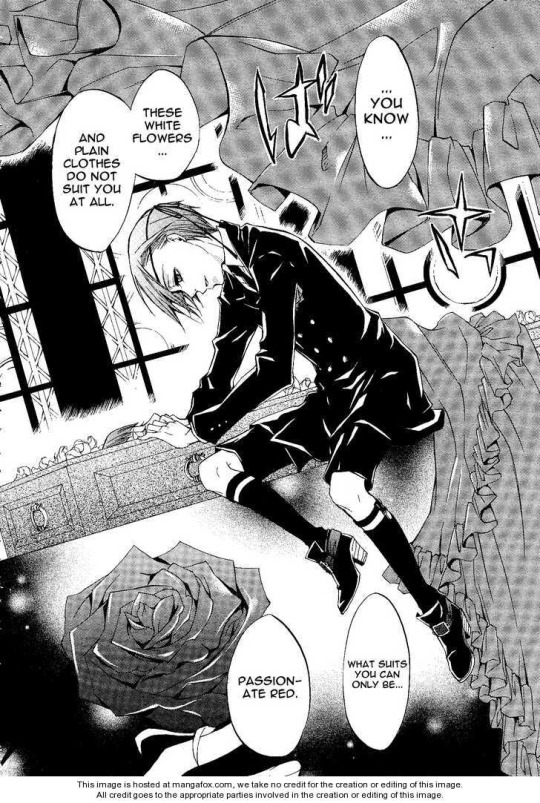
However, since we know he couldn’, here is how I interpreted the funerals: First of all, I do think Yana intended to show a parallel between Ciel and Vincent here, but in any case, since Vincent telling Ann that the red color suited her was before Ciel was born, Ciel probably always knew Ann to wear the color red.
The “Madam Red” nickname was something society came up with but I think that even “Aunt Ann” for Ciel is associated with the red color, so even if white is supposed to represent purity (hence the white dress at her funerals), Ciel probably thought that white wasn’t something that defined her well, hence why he brought a red dress.
Madam Red was the crazy alter born from sadness and despair (she went through a lot), but his aunt died as “Ann” when she refused to kill him and so I see the red dress as a nod from Ciel to his aunt Ann, not to “Jack the Ripper”.
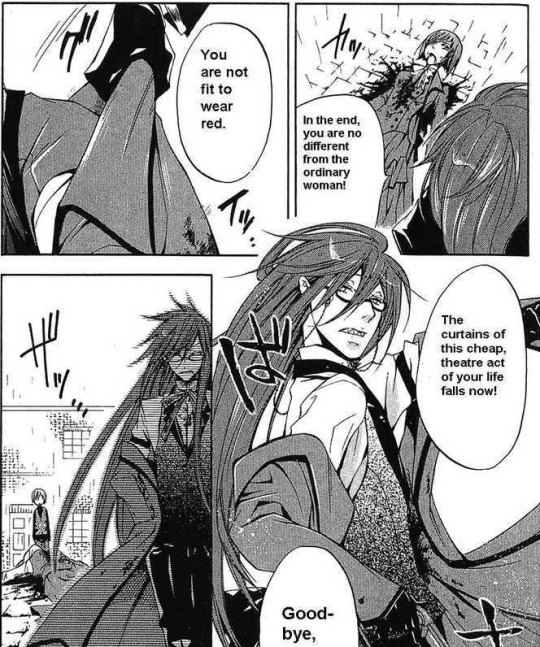
That’s the first reason. Another reason could be because of what Grell said…
“You are not fit to wear red.”
Ciel loved his aunt, even if he might not admit it, and he probably always associated the red color with her as I explained, so him bringing a red dress to her funerals was probably a way for him and Ann to reject Grell’s words when they killed her.
That’s how I see it anyway, but I’m sure other people can offer different interesting interpretations 🙂 so it’s for you to see which interpretation suits you the best.
I hope it helps a little, thanks again for passing by. 🙂
I disagree that Ciel had not seen Madam Red’s cinematic record. We are made to recall Vincent’s words to a young Ann, as seen in her record.
(Chap. 10, pg. 2)
On the next page after he declares red suits her, Ciel recalls the words of his father. We even see a small image of the scene of a young Ann and Vincent together, that day when Vincent complimented her hair.
(Chap. 13, pg. 9)
How else would Ciel have been able to recall and utter those exact words (the translations differ here, though, due to different translators it seems), if he had not seen the very moment they were uttered before?
Aside from that, I do think Ciel also said it to refute Grell’s words from before 🙂
Sorry but Ciel, as a human, can’t see cinematic records (except for his own at the time of his death) 😉
So no, I really think it was to show a parallel between father and son (as @kashikoikawaiisaschachen also said). It’s also not impossible that during Ciel’s childhood, Ciel asked why his aunt would always wear red clothes (simply because of curiosity) and his dad gave him a similar answer to what he once told her.
Besides, if Ciel had really seen his aunt’s record he’d have noted one thing in particular…
She actually hated that color in the end. She came to love it because of Vincent’s compliment but “crimson red” turned out to be a hateful sight for her since it took away the man she loved as well as her sister (= fire).
So nope, I think Ciel thought she liked the color red because she always wore it, but that’s proof enough for me he actually didn’t watch his aunt’s record, otherwise he’d have known her ambivalence towards it.
EDIT: Just to clarify before I get more questions on the subject, Ciel apparently couldn’t see cinematic records until the Campania arc and for now, without Yana’s confirmation, I’d say he remains unable to see them but, considering what the Shinigamis said in ch103, it’s very possible that this will change soon, since it seems his lineage as a Phantomhive has to do with someone/something supernatural. [x]
I wonder if anybody in the fandom was a little… put out by Cheslock’s remark here. If so, bear with me. It is actually very true that women are more drawn to things like fortune telling that men, generally speaking. You may have had experience of this yourself.
In any case, in contemporary Western culture, women consult fortune tellers more than men, and even, in some cases, build lifelong relationships with them (Fortune Telling with Cards, by P. Foli). I think, though I’m not sure, this could also apply to Eastern culture too. In both cases, young women are particularly susceptible to ‘tellers’, unsure and unsteady as they embark on adulthood (
Fortune-Telling: A Science of Mystery, by Ching-Huang Wu, pg. 5).
I found a study dealing with supernatural experiences (from here), dealing specifically with feeling in touch with the dead, and of consulting physics. It found that having been in touch with a dead person is more common among women than men (33% vs. 26%). Women were also twice as likely to have consulted a fortuneteller or psychic (20% vs. 10%).
Another indication of this comes from the great number of advertisements for commercial fortune-telling services in magazines aimed at women, while such advertisements appear virtually unknown in magazines aimed specifically at men.
But this leaves the question, why? Why are women more disposed to visiting the likes of Bravat than men? Are, as I’ve seen suggested, women more superstitious, and thus more prone to believe in visions and dreams and miraculous interferences? Especially when they are driven by a passion, such as love. Such as this lady:
Could religious devotion play a part in the disparity between the sexes on this issue?
Or could it be that, as women often rely on the attitudes and decisions of their friends when in groups, and so more likely to be influenced by the opinions of others, they are more willing to take advice from fortune tellers (and believe said advice)?
Honestly I think it’s all about the personality and the different education between girls and boys, especially since it’s the Victorian era we’re talking about when it comes to Bravat and the Sphere music hall in Kuroshitsuji.
As said in ch58…
Girls are supposed to be beautiful and naive angels in the Victorian era, especially for aristocracy. Careful, I’m not saying they are stupid since they are taught a lot, but compared to men who are engaging into political and financial discussions, there is technically a real “gap” between men and women in the Victorian era (again especially for the upper classes).
I still believe that nowadays, personalities and even education play a role into believing into this kind of thing: for example I’m a girl and I laughed when a friend asked me if I’d “go see this amazing fortune teller” (and God knows I love my fantasy books lol). Three male friends of mine went once or twice on the other hand so maybe they’re just more interested and believing of that kind of things than I am, even though I’m a girl and generally way more invested in supernatural through fiction than them! 😉 (my life is so interesting)
Anyway back to the subject at hand, to give you a more Kuro example of what I mean when I say personalities also play a role when it comes to believing and consulting fortune tellers like Bravat…
It appears there are men (and children but children are innocent little creatures who need to dream) who are actually interested in what Bravat would have to say about others and themselves, so there you see? It’s not only about girls haha! 🙂
One more thing, I think that if Ed and Lizzie’s mom (so a noble woman of the Victorian era) were to come to the Sphere music hall and Bravat were to offer her a consultation, she’d literally blink and then cut his bangs with her sword lol. On the other hand try imagining Druitt meeting Bravat, this will give you amusing thoughts haha!
I really think it’s all about whether you believe in it or not, boys or girls, Victorian era or nowadays, granted that girls in the Victorian era were probably raised in such a way that they’d believe in this kind of things more than boys would! 😉
Personally I think, the fact that statistics show that, even today, with women today having far, far greater opportunities than their foremothers in terms of work, relationships, etc., that women are more inclined than men to consult fortune tellers, is indicative of something a bit deeper than education and how one is raised.
Of course, there are a lot of women who would scoff at Bravat and keep clear of him, just as some men would. The point I was putting out was not that women are all bound to fall hook, line and sinker for diviners, but rather that they are, for reasons that continue to influence today, simply more inclined to do so.
And it is not to say that men aren’t also susceptible; on the contrary, the stats show there are a number of men who also consult the likes of Bravat, as the men shown in the Kuro manga are.
I think it has more to do with nature rather than nurture, but that’s my take on it.
The simple fact that you’re saying yourself that “a lot of women would scoff at Bravat and keep clear of him, just as some men would” directly contradicts your own argument that “it has more to do with nature than nurture” actually lol 🙂 If that was indeed a nature thing then almost all women no matter their psychology would be enthralled by fortune tellers, but you just agreed yourself that it was not the case.
Maybe I’m too influenced by my studies but I’m a fervent believer of the biopsychosocial model be it for diseases or for human/animal psychology, because that explains perfectly why women (men too but we were talking about women particularly) are so different in manners and behaviorism when compared to one or several centuries ago.
In the case that something stops being a generality to become an ensemble of particular cases without a really astounding majority above 90%, especially when it comes to psychological/interest differences between genders, then it stops being defined by Nature. That’s how I was taught things haha. 🙂
That being said, I hope you take no offence in my answer, I don’t mind if you prefer your own interpretation but that’s just a bit too easy as a reasoning for my taste. 😉
By ‘more to do with’ I meant that nature could be more of an influence, but not to rule out the ‘nurture’ idea, because, as you say, if it was entirely down to nature, then the disparity between male and females consulting the Bravats of the world would be far greater.
Ah, I agree with your family friend that “those who consult fortune tellers are those who don’t know how to think”, except that, well, I wouldn’t have put it like that indeed since it could be interpreted as judgemental (and I try never to be judgemental when it comes to this kind of things as you probably understood :)) but I get the meaning. To quote the words of a female friend of mine who recently went to see a fortune teller: “you don’t go see a fortune-teller when everything rolls perfectly in your life”, and I believe that she’s right and besides, it totally relates to what you were saying.
I agree that fortune tellers, especially nowadays but also as it was described in Kuro recently, are generally consulted for their advice or as a mean of boosting the person’s self-confidence when it comes to subjects that always bring stress in the everyday life. Same about your example with Lizzie, I totally agree that this is probably exactly what’s going on in her head, but we’re basically rambling away from your initial question (not that I mind the length or the discussion ;)).
Your first post wasn’t about “why are fortune tellers consulted” but why there are apparently more women than men going to consult them, to which I answered that I believe this comes down to mostly personalities and then education, not gender.
Actually, I guess you can say that nature shapes the personalities according to the gender to some extent (since there are general behavioral patterns that totally depend on your gender, which is why nature isalwaysan influence when it comes to gender differences on a behavioral level), but for me nurture definitely remains the main answer to your initial question when it comes to something like fortune-telling. 🙂
As I was saying though, you obviously don’t have to agree since it’s an open question. We apparently seem to share the same opinion on fortune-tellers but if you believe that their clients being more women than men is something influenced by genetics (because by saying nature and genders are the predominant influence that’s what you’re implying) that’s definitely your right.
Thanks for the discussion, it was really interesting! 🙂
(And no, I’m not studying genders particularly ;))
I wonder if anybody in the fandom was a little… put out by Cheslock’s remark here. If so, bear with me. It is actually very true that women are more drawn to things like fortune telling that men, generally speaking. You may have had experience of this yourself.
In any case, in contemporary Western culture, women consult fortune tellers more than men, and even, in some cases, build lifelong relationships with them (Fortune Telling with Cards, by P. Foli). I think, though I’m not sure, this could also apply to Eastern culture too. In both cases, young women are particularly susceptible to ‘tellers’, unsure and unsteady as they embark on adulthood (
Fortune-Telling: A Science of Mystery, by Ching-Huang Wu, pg. 5).
I found a study dealing with supernatural experiences (from here), dealing specifically with feeling in touch with the dead, and of consulting physics. It found that having been in touch with a dead person is more common among women than men (33% vs. 26%). Women were also twice as likely to have consulted a fortuneteller or psychic (20% vs. 10%).
Another indication of this comes from the great number of advertisements for commercial fortune-telling services in magazines aimed at women, while such advertisements appear virtually unknown in magazines aimed specifically at men.
But this leaves the question, why? Why are women more disposed to visiting the likes of Bravat than men? Are, as I’ve seen suggested, women more superstitious, and thus more prone to believe in visions and dreams and miraculous interferences? Especially when they are driven by a passion, such as love. Such as this lady:
Could religious devotion play a part in the disparity between the sexes on this issue?
Or could it be that, as women often rely on the attitudes and decisions of their friends when in groups, and so more likely to be influenced by the opinions of others, they are more willing to take advice from fortune tellers (and believe said advice)?
Honestly I think it’s all about the personality and the different education between girls and boys, especially since it’s the Victorian era we’re talking about when it comes to Bravat and the Sphere music hall in Kuroshitsuji.
As said in ch58…
Girls are supposed to be beautiful and naive angels in the Victorian era, especially for aristocracy. Careful, I’m not saying they are stupid since they are taught a lot, but compared to men who are engaging into political and financial discussions, there is technically a real “gap” between men and women in the Victorian era (again especially for the upper classes).
I still believe that nowadays, personalities and even education play a role into believing into this kind of thing: for example I’m a girl and I laughed when a friend asked me if I’d “go see this amazing fortune teller” (and God knows I love my fantasy books lol). Three male friends of mine went once or twice on the other hand so maybe they’re just more interested and believing of that kind of things than I am, even though I’m a girl and generally way more invested in supernatural through fiction than them! 😉 (my life is so interesting)
Anyway back to the subject at hand, to give you a more Kuro example of what I mean when I say personalities also play a role when it comes to believing and consulting fortune tellers like Bravat…
It appears there are men (and children but children are innocent little creatures who need to dream) who are actually interested in what Bravat would have to say about others and themselves, so there you see? It’s not only about girls haha! 🙂
One more thing, I think that if Ed and Lizzie’s mom (so a noble woman of the Victorian era) were to come to the Sphere music hall and Bravat were to offer her a consultation, she’d literally blink and then cut his bangs with her sword lol. On the other hand try imagining Druitt meeting Bravat, this will give you amusing thoughts haha!
I really think it’s all about whether you believe in it or not, boys or girls, Victorian era or nowadays, granted that girls in the Victorian era were probably raised in such a way that they’d believe in this kind of things more than boys would! 😉
Personally I think, the fact that statistics show that, even today, with women today having far, far greater opportunities than their foremothers in terms of work, relationships, etc., that women are more inclined than men to consult fortune tellers, is indicative of something a bit deeper than education and how one is raised.
Of course, there are a lot of women who would scoff at Bravat and keep clear of him, just as some men would. The point I was putting out was not that women are all bound to fall hook, line and sinker for diviners, but rather that they are, for reasons that continue to influence today, simply more inclined to do so.
And it is not to say that men aren’t also susceptible; on the contrary, the stats show there are a number of men who also consult the likes of Bravat, as the men shown in the Kuro manga are.
I think it has more to do with nature rather than nurture, but that’s my take on it.
The simple fact that you’re saying yourself that “a lot of women would scoff at Bravat and keep clear of him, just as some men would” directly contradicts your own argument that “it has more to do with nature than nurture” actually lol 🙂 If that was indeed a nature thing then almost all women no matter their psychology would be enthralled by fortune tellers, but you just agreed yourself that it was not the case.
Maybe I’m too influenced by my studies but I’m a fervent believer of the biopsychosocial model be it for diseases or for human/animal psychology, because that explains perfectly why women (men too but we were talking about women particularly) are so different in manners and behaviorism when compared to one or several centuries ago.
In the case that something stops being a generality to become an ensemble of particular cases without a really astounding majority above 90%, especially when it comes to psychological/interest differences between genders, then it stops being defined by Nature. That’s how I was taught things haha. 🙂
That being said, I hope you take no offence in my answer, I don’t mind if you prefer your own interpretation but that’s just a bit too easy as a reasoning for my taste. 😉



 midnight-in-town
