interesting that iroh says this to zuko in an episode that deals explicitly with authority brainwashing. also interesting that i’m depressed now!
also interesting that this is the angriest we’ve seen iroh yet, and the closest we’ve come to him calling his brother out.
i mean, sure, some of the anger is obviously him being afraid that his second son nephew will literally stubborn himself to death. but the crux of the argument, the emotional heart, is him pretty much explicitly telling zuko “your father did not do well by you, and it hurt you in the past, and it’s still hurting you now.”
iroh is fucking furious with his brother and at this point he’s barely even hiding it
wait god this makes it so much better when zuko asks if iroh thinks he should try to get along with azula because she’s family and iroh is like “uh no she’s the worst.” it’s like
zuko: you’re gonna tell me that family’s important and i have to love her because she’s my sister, right?
iroh, who is trying to gently help zuko realize that his brother is an absolute moral chemical fire of a human being & doesn’t deserve zuko’s devotion:
I’ve touched on it before but, one of the things Avatar does really well is subvert tropes to give charactere agency. While the Gaang tries to go by the book by getting people to rebel, and rise up, they always fail, with it being the job of the characters that they are trying to inspire to rise up, rebel, and fight, and to do so for their own reasons.
It would have been so easy to just have people like Yue, the guys from “Imprisoned,” Toph in “The Blind Bandit,” and Mai in “The Boiling Rock” and “The Beach” listen to Sokka, Zuko, Katara, or Aang, but they don’t. They’re all allowed to make their own decisions, on their own time, for their own reasons.
But it doesn’t stop there.
Katara doesn’t just forgive Zuko because he wants her to. She’s allowed to take her time.
The people in “Zuko Alone’ don’t just forgive Zuko because he did a good thing. No, they’re still very much prejudiced. This consequently ties in well with Zuko’s arc since he doesn’t get to be viewed as some kind of Fireman Savior–an image of the Fire Nation created by Fire Nation imperialists like Sozin.
This is in contrast to the people from “The Painted Lady.” While the villagers reject the Gaang at first because of who they are, they eventually warm up to them. But again, it’s not automatic. They change their minds gradually, and they’re allowed to do it on their own.
One of the many reasons i love “The Beach” episode in AtLA is it really shows us how political dysfunction/ imperialist expansion filters down into the interpersonal, like you can’t be part of an imperialist national mechanism without that shit fucking you over on a personal level: there’s Zuko and Azula with their problematic family, there’s Mai and then Ty Lee who was tired of being a carbon copy I mean these are all kids that are stifling under the narrow roles ascribed to them (which is what happens in highly industrialized, capitalist nations which prioritize efficiency, compliance and utility rather than creative expression and interconnectedness). Ofc the Gaang has family issues too – Toph and her parents, Katara and Sokka’s early loss of a parent figure etc – but you don’t get the same sense of dysfunction and trauma and pain that you do with Mai/Ty Lee/Azula/ Zuko, or at least it feels different. And I really wanna know more about these four FN kids in their childhood and how they found each other and formed these bonds through and in spite of their dysfunction and ugh feels about kids growing up during war i mean this is really one of the strongest things about the show: war and militarization affects everyone in some way, not just in terms of losing land and resources but also in how fully we can engage our own humanity
Yes, he hugged Iroh, yes, he made up with Iroh, yes, Iroh’s his family…but he always had Iroh throughout the show. His very first scene was him talking with Iroh, and his uncle always had his back; the only separation between those two happened in Book Three (and that brief portion of Book Two).
But Mai is the one there to welcome him home.
And what’s more?
It’s not just Zuko’s resolution here.
It’s also Mai finally being able to express herself, finally being able to hug Zuko, to welcome him back and to be open with him—she saved his life, she took a stand for what she believed in and what she wanted, and she gave up her safety and security…and now she’s found it again. She’s finally got the life she wanted.
Both of them are hugging here because they have both finally found what they wanted most in the world.
I’ve seen the balance of yin and yang being used to support the Katara/Zuko (Zutara) ship, and it’s honestly so hilarious?
I mean let’s set aside the fact that in my culture yin and yang in the context of a man and a woman means, well, sex. Not even in a serious sense, more like a parody of how your 96-year-old grandfather might pressure you and your partner to give him great-grandchildren.
I mean, the sexual innuendo aspect is the least of my objections to fandom’s misuse of yin and yang, but I thought I’d put it out there because you can imagine how I feel when I read all this stuff being discussed in deadly earnest and all I can think is “archaic sex joke.”
Like I said, though, let’s set the sexual connotations aside and just look at yin and yang in the original, philosophical sense. Even here fandom gets it wrong when it comes to Zutara. Let me explain why Zutara is not the yin-yang ship, Mai/Zuko (Maiko) and Aang/Katara (Kataang) are.
Azula is one of the most fascinating and complex villains in children’s media, or indeed in any media. She is both abuser and victim, both deeply cruel and deeply afraid. Often, discussion of her breaks into two camps, either she was born the way she is, or that she was abused, and she was made into the character we see onscreen by that abuse. Either she is a “psychopath” (an outdated term that has been widely misunderstood and keeps shifting in meaning), and she was born the way she is, and she either wasn’t abused, or abuse didn’t affect her, or she was abused, and how she was raised made her into who she is. I don’t think either of those positions are correct. There is no code that says that predators don’t abuse other predators, and there is nothing in the world that makes abuse magically not damaging. I have spent a great deal of time figuring out what makes this character tick, and what made her stop ticking at the end. So how did nurture and nature come together to make Azula? Bear with me, it’s a bit of a story.
Sibling rivalry is often a trite story of one sibling hating the other out of jealousy. On the surface, the Zuko and Azula may look that way. They have no problem blasting fire and lightning at each other and both of their parents had a favorite. But there’s so much more to it.
First of all, I would argue that in spite of many near-fatal encounters, they don’t necessarily hate each other. It’s far more complicated than that. How they view each other is closely tied to how they view themselves.
For most of Zuko’s life, Azula is the standard he’s held to. She’s ambitious, ruthless, and a prodigy. No matter what he does, he can’t earn their father’s approval like she can. And she rubs it in his face constantly. When Azula is cruel to Zuko, Ozai affirms that she’s not wrong to do so. Zuko rarely argues with her because he’s been conditioned to believe she’s right. Zuko has internalized the blame for how his father treats him rather than project it onto Azula, and accepts how she treats him as normal. He has plenty of bitter feeling toward her, but none quite as clear as hate.
Azula’s view of Zuko is even more convoluted. The first time we see Azula, she’s smiling because their father is about to burn him. The next time they meet, she berates him for being a failure of a son. It looks like she enjoys watching him suffer.
But when Zuko helps “kill” the Avatar in Ba Sing Se, we get to see them in a new context. In the rare moments that they aren’t pitted against each other by the ever looming presence of their father… they actually get along fine.
Every time Azula appeared happy to see Zuko suffering, it was at the hands of their father. It wasn’t just that Ozai hurt Zuko, it what that Ozai hurt Zuko and not her. Every time Ozai insulted or injured her brother, it cemented Azula’s position as the favorite child. And she had to stay the favorite child because she’s seen what would happen to her if she wasn’t. Deep down, she knows just how conditional her father’s positive regard is. When Ozai leaves her in the Fire Nation while invading the Earth Kingdom, the first words out of her mouth are “You can’t treat me like Zuko”. Being better than Zuko is part of her identity.
When Zuko defects from the Fire Nation and begins to succeed without meeting, or even trying to meet, the standards set by their father, it throws her priorities into doubt. In her mind, Zuko is supposed to fail. But she isn’t truly unnerved until she’s betrayed by Mai and Ty Li.
She is incapable of understanding why Mai would chose Zuko, and this drags to the surface her inability to understand why her mother preferred Zuko. She believed her mother loved Zuko and not her. Now Mai, her closest friend, loves Zuko and not her.
This conflicts with her entire view of the world. She sees the worth of a person as equal to their quantifiable skills and accomplishments. She has been admired, respected, and feared, but as far as Azula believes, no one has ever loved her. She was a prodigy who did everything right, while Zuko was the family screw up. Yet people loved him and not her.
For years, being better than Zuko was how Azula measured herself. Ozai said Zuko was lucky to be born. That he was worthless, weak, disrespectful, and both his children believed him. When Zuko left, he finally saw that Ozai was wrong about him. When Zuko returns during Sozin’s comet, Azula too is forced to see that her perception is wrong.
Zuko has become the embodiment of everything she lacks. She thought he was weak, but he’s not afraid enough to fight her fairly as an equal. She thought he was dishonorable, but really he was independent enough to break away from their father’s control. She thought he was worthless, but he’s found people who care about him in spite of his flaws.
Azula isn’t just trying to kill him, but everything he represents. And when she can’t, she breaks. Zuko is still standing. She has nothing left.
Word of God (Bryke) confirmed that at the end of the Agni Kai, Zuko felt pity rather than hate for his sister. This continues into the comics as he genuinely tries to help her. He knows that while she may not have been overtly abused like he was, she was raised in the same web of lies, agendas, and violence.
Their past left them both unable to trust people. Azula controlled everyone around her with fear. Zuko shut other people out and tried to do everything on his own. It isn’t until Zuko has left his old life behind that he slowly begins to let people in.
While Azula hangs onto the beliefs of Ozai and the Fire Nation, Zuko can see their situation from the outside. He sees two screwed up teenagers who spent their lives fighting their father’s war, manipulated into a conflict that isn’t their fault, forced to kill each other over choices made a century before they were born. It took Zuko years to figure out the hell that was his home life wasn’t his fault, but only a few minutes to see that it wasn’t Azula’s either.
“Who’s
your favorite character?” I hear that question come up a lot over Avatar: The Last Airbender, a show
particularly near and dear to me. Iroh and Toph get tossed around a lot. Zuko
is very popular. Sokka has his fans. But something I’ve noticed? Aang very
rarely gets the pick. When he comes up, it’s usually in that “Oh, and also…”
kind of way. Which is strange, I think, considering he’s the main character,
the titular airbender, of the entire show.
I never
really thought much about it until a couple weeks ago when I finished my annual
re-watch of the series and found myself, for the first time, specifically focused
on Aang’s arc. Somehow, I never really paid that much attention to him before.
I mean sure, he’s front and center in most episodes, fighting or practicing or
learning big spiritual secrets, and yet, he always feels a little overshadowed.
Katara takes care of the group. Sokka makes the plans. Zuko has the big, heroic
Joseph Campbell journey. Aang…goofs around. He listens and follows and plays
with Momo. And yes, at the end his story gets bigger and louder, but even then
I feel like a lot of it dodges the spotlight. And here’s why:
Avatar casts the least
traditionally-masculine hero you could possibly write as the star of a fantasy
war story. Because of that, we don’t see Aang naturally for everything he is,
so we look elsewhere.
To show
what I mean, I want to talk about some of the show’s other characters, and I
want to start with Zuko. Zuko is the hero we’re looking for. He’s tall and hot and
complicated. He perseveres in the face of constant setbacks. He uses two swords
and shoots fire out of his hands. He trains with a wise old man on ship decks
and mountaintops. Occasionally he yells at the sky. He’s got the whole
180-degree moral turn beat for beat, right down to the scars and the sins-of-the-father
confrontation scene. And if you were going into battle,
some epic affair with battalions of armor-clad infantry, Zuko is the man you’d
want leading the charge, Aragorn style. We love Zuko. Because Zuko does what he’s
supposed to do.
Now let’s
look at Katara. Katara doesn’t do what she’s supposed to do. She doesn’t care
about your traditionally gender dynamics because she’s too busy fighting
pirates and firebenders, planning military operations with the highest ranking
generals in the Earth Kingdom, and dismantling the entire patriarchal structure
of the Northern Water Tribe. Somewhere in her spare time she also manages to
become one of the greatest waterbenders in the world, train the Avatar, defeat
the princess of the Fire Nation in the middle of Sozin’s Comet and take care of
the entire rest of the cast for an entire year living in tents and caves. Katara
is a badass, and we love that.
So what
about Aang? When we meet Aang, he is twelve years old. He is small and his
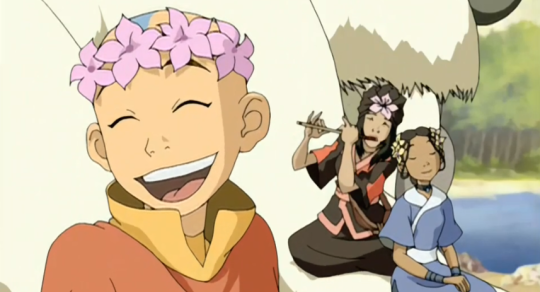
voice hasn’t changed yet. His hobbies include dancing, baking and braiding
necklaces with pink flowers. He loves animals. He doesn’t eat meat. He despises
violence and spends nine tenths of every fight ducking and dodging. His only
“weapon” is a blunt staff, used more for recreation than combat. Through the
show, Aang receives most of his training from two young women – Katara and Toph
– whom he gives absolute respect, even to the point of reverence. When he
questions their instruction, it comes from a place of discomfort or anxiety,
never superiority. He defers to women, young women, in matters of strategy and
combat. Then he makes a joke at his own expense and goes off to feed his pet lemur.
Now
there’s a perfectly reasonable explanation for all this, and it’s the one that
shielded Aang from the heroic limelight in my eyes for ten years. The reasoning
goes like this: Aang is a child. He has no presumptuous authority complex, no
masculinity anxiety, no self-consciousness about his preferred pastimes,
because he’s twelve. He’s still the hero, but he’s the prepubescent hero, the
hero who can’t lead the charge himself because he’s just not old enough. The
problem is, that reasoning just doesn’t hold up when you look at him in the
context of the rest of the show.
Let’s
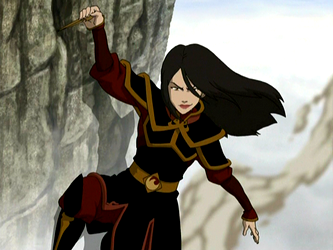
look at Azula. Aside from the Avatar himself, Zuko’s sister is arguably the
strongest bender in the entire show. We could debate Toph and Ozai all day, but
when you look at all Azula does, the evidence is pretty damning. Let’s make a
list, shall we?
Azula
completely mastered lightning, the highest level firebending technique, in her
spare time on a boat, under the instruction of two old women who can’t even
bend.
Azula led
the drill assault on Ba Sing Sae, one of the most important Fire Nation
operations of the entire war, and almost succeeded in conquering the whole Earth
Kingdom.
Azula then
bested the Kyoshi Warriors, one of the strongest non-bender fighting groups in
the entire world, successfully infiltrated the Earth Kingdom in disguise,
befriended its monarch, learned of the enemy’s most secret operation,
emotionally manipulated her older brother, overthrew the captain of the secret
police and did conquer the Earth
Kingdom, something three Fire Lords, numerous technological monstrosities, and
countless generals, including her uncle, failed to do in a century.
And she
did this all when she was fourteen.
That last
part is easy to forget. Azula seems so much her brother’s peer, we forget she’s
the same age as Katara. And that means that when we first meet Azula, she’s
only a year older than Aang is at the end of the series. So to dismiss Aang’s
autonomy, maturity or capability because of his age is ridiculous,
understanding that he and Azula could have been in the same preschool class.
We must
then accept Aang for what he truly is: the hero of the story, the leader of the
charge, who repeatedly displays restraint and meekness, not because of his age,
not because of his upbringing, not because of some character flaw, but because
he chooses too. We clamor for strong female characters, and for excellent
reason. But nobody every calls for more weak
male characters. Not weak in a negative sense, but weak in a sense that he
listens when heroes talk. He negotiates when heroes fight. And when heroes are
sharpening their blades, planning their strategies and stringing along their
hetero love interests, Aang is making jewelry, feeding Appa, and wearing that
flower crown he got from a travelling band of hippies. If all Aang’s hobbies
and habits were transposed onto Toph or Katara, we’d see it as a weakening of
their characters. But with Aang it’s cute, because he’s a child. Only it isn’t,
because he’s not.
Even in
his relationship with Katara, a landmark piece of any traditional protagonist’s
identity, Aang defies expectations. From the moment he wakes up in episode one,
he is infatuated with the young woman who would become his oldest teacher and
closest friend. Throughout season one we see many examples of his puppy love
expressing itself, usually to no avail. But there’s one episode in particular
that I always thought a little odd, and that’s Jet.
In Jet, Katara has an infatuation of her
own. The titular vigilante outlaw sweeps her off her feet, literally, with his
stunning hair, his masterful swordsmanship and his apparent selflessness. You’d
think this would elicit some kind of jealousy from Aang. There’s no way he’s
ignorant of what’s happening, as Sokka sarcastically refers to Jet as Katara’s
boyfriend directly in Aang’s presence, and she doesn’t even dispute it. But
even then, we never see any kind of rivalry manifest in Aang. Rather, he seems
in full support of it. He repeatedly praises Jet, impressed by his leadership
and carefree attitude. Despite his overwhelming affection for Katara, he
evaluates both her and Jet on their own merits as people. There is no sense of
ownership or macho competition.
Contrast
this with Zuko’s reaction to a similar scenario in season three’s The Beach. Zuko goes to a party with his
girlfriend, and at that party he sees her talking to another guy. His reaction?
Throwing the challenger into the wall, shattering a vase, yelling at Mai, and
storming out. This may seem a little extreme, but it’s also what we’d expect to
an extent. Zuko is being challenged. He feels threatened in his station as a
man, and he responds physically, asserting his strength and dominance as best
he can.
I could
go on and on. I could talk about how the first time Aang trains with a
dedicated waterbending master, he tries to quit because of sexist double
standards, only changing his mind after Katara’s urging. I could talk about how
Aang is cast as a woman in the Fire Nation’s propaganda theatre piece bashing
him and his friends. Because in a patriarchal society, the worst thing a man
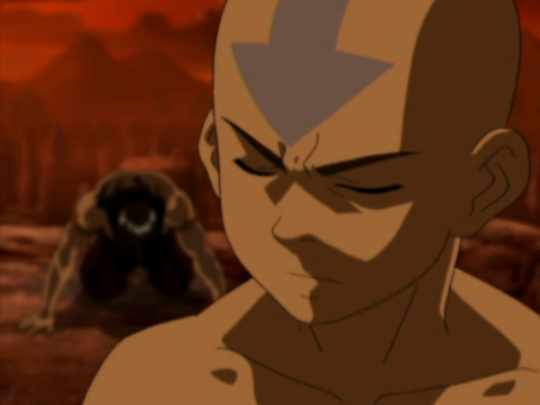
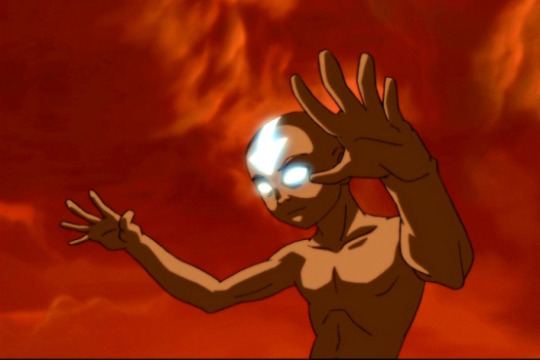
can be is feminine. I could talk about the only times Aang causes any kind of
real destruction in the Avatar state, it’s not even him, since he doesn’t gain
control of the skill until the show’s closing moments. Every time he is powerless
in his own power and guilt-ridden right after, until the very end when he finally
gains control, and what does he do with all that potential? He raises the
rivers, and puts the fires out.
Aang
isn’t what he’s supposed to be. He rejects every masculine expectation placed
on his role, and in doing so he dodges center stage of his own show. It’s
shocking to think about how many times I just forgot about Aang. Even at the
end, when his voice has dropped and his abs have filled in, we miss it. Zuko’s
coronation comes and we cheer with the crowd, psyched to see our hero crowned.
Then the Fire Lord shakes his head, gestures behind him and declares “the real
hero is the Avatar.” It’s like he’s talking to us. “Don’t you get it?” he asks.
“Did you miss it? This is his story. But you forgot that. Because he was small.
And silly. And he hated fighting. And he loved to dance. Look at him,” Zuko
seems to say. “He’s your hero. Avatar Aang, defier of gender norms, champion of
self-identity, feminist icon.”
what she says: I’m fine
what she means: Iroh, though. He could’ve stayed in the Fire Nation and lived a cushy life. He could’ve had whatever he wanted – a comfortable home, a slew of servants, a tea shop – any retiree’s dream following a long, highly successful career in a war. He could’ve been mostly happy and mostly content, free to do whatever he pleased really as the Fire Lord’s brother and a former general. He didn’t have to do any of the things he did for Zuko. He really didn’t. Zuko wasn’t even his kid! But guess what? Iroh loved Zuko like his own son. And Iroh left everything he knew to follow this asshole of a kid around the world on a pointless mission all the while loving him like Zuko had never been loved before and I just… Iroh, though. Uncle Iroh.
Can we talk about this scene
for a minute? Because I tear up literally every damn time I watch it.
After losing his son, Iroh
fought tirelessly to save his nephew from Ozai’s brainwashing, no matter how
hard Zuko tried to push him away. But even after years of sticking by him
through every dead end and reckless gambit, Zuko still goes back to his awful father. Once
again, Iroh couldn’t save his son and it just kills him.
Then the kid shows up with team Avatar, because it turns out
some of those proverbs got through to him after all.
But the part that really gets me is Zuko’s perspective.
Sitting outside that tent,
he’s so damn scared. He’s so convinced Iroh hates him, he won’t even go in
without a pep talk from Katara. Everyone else can see that Iroh will be proud
of what his nephew has done since they last met, but Zuko can’t. When Zuko goes
in to see the family he disappointed, he’s braced for yelling and fire and rage
because that’s what he’s been raised to expect when he screws up. Pissing off
his father got him disgraced, burned, tossed in the street, told he didn’t
deserve to be alive, and shot at with lightening. A lifetime of experience says
he should be
scared. He doesn’t expect to be forgiven, he just wants Iroh to know he’s
sorry.
And then Iroh’s not even mad. NOT EVEN MAD.
Mercy and compassion are so alien to Zuko that immediate forgiveness wasn’t
even a remote possibility. He’s so utterly confused, but at the same time, so,
so relieved. He hasn’t lost his only family. The only person who stayed by him
all those years in exile. The only father who loved him.
They both thought they’d lost
the only family they had left. Instead, they find themselves closer than
they’ve ever been. And I tear up every damn time.


 midnight-in-town