I’ve seen the balance of yin and yang being used to support the Katara/Zuko (Zutara) ship, and it’s honestly so hilarious?
I mean let’s set aside the fact that in my culture yin and yang in the context of a man and a woman means, well, sex. Not even in a serious sense, more like a parody of how your 96-year-old grandfather might pressure you and your partner to give him great-grandchildren.
I mean, the sexual innuendo aspect is the least of my objections to fandom’s misuse of yin and yang, but I thought I’d put it out there because you can imagine how I feel when I read all this stuff being discussed in deadly earnest and all I can think is “archaic sex joke.”
Like I said, though, let’s set the sexual connotations aside and just look at yin and yang in the original, philosophical sense. Even here fandom gets it wrong when it comes to Zutara. Let me explain why Zutara is not the yin-yang ship, Mai/Zuko (Maiko) and Aang/Katara (Kataang) are.
“Who’s
your favorite character?” I hear that question come up a lot over Avatar: The Last Airbender, a show
particularly near and dear to me. Iroh and Toph get tossed around a lot. Zuko
is very popular. Sokka has his fans. But something I’ve noticed? Aang very
rarely gets the pick. When he comes up, it’s usually in that “Oh, and also…”
kind of way. Which is strange, I think, considering he’s the main character,
the titular airbender, of the entire show.
I never
really thought much about it until a couple weeks ago when I finished my annual
re-watch of the series and found myself, for the first time, specifically focused
on Aang’s arc. Somehow, I never really paid that much attention to him before.
I mean sure, he’s front and center in most episodes, fighting or practicing or
learning big spiritual secrets, and yet, he always feels a little overshadowed.
Katara takes care of the group. Sokka makes the plans. Zuko has the big, heroic
Joseph Campbell journey. Aang…goofs around. He listens and follows and plays
with Momo. And yes, at the end his story gets bigger and louder, but even then
I feel like a lot of it dodges the spotlight. And here’s why:
Avatar casts the least
traditionally-masculine hero you could possibly write as the star of a fantasy
war story. Because of that, we don’t see Aang naturally for everything he is,
so we look elsewhere.
To show
what I mean, I want to talk about some of the show’s other characters, and I
want to start with Zuko. Zuko is the hero we’re looking for. He’s tall and hot and
complicated. He perseveres in the face of constant setbacks. He uses two swords
and shoots fire out of his hands. He trains with a wise old man on ship decks
and mountaintops. Occasionally he yells at the sky. He’s got the whole
180-degree moral turn beat for beat, right down to the scars and the sins-of-the-father
confrontation scene. And if you were going into battle,
some epic affair with battalions of armor-clad infantry, Zuko is the man you’d
want leading the charge, Aragorn style. We love Zuko. Because Zuko does what he’s
supposed to do.
Now let’s
look at Katara. Katara doesn’t do what she’s supposed to do. She doesn’t care
about your traditionally gender dynamics because she’s too busy fighting
pirates and firebenders, planning military operations with the highest ranking
generals in the Earth Kingdom, and dismantling the entire patriarchal structure
of the Northern Water Tribe. Somewhere in her spare time she also manages to
become one of the greatest waterbenders in the world, train the Avatar, defeat
the princess of the Fire Nation in the middle of Sozin’s Comet and take care of
the entire rest of the cast for an entire year living in tents and caves. Katara
is a badass, and we love that.
So what
about Aang? When we meet Aang, he is twelve years old. He is small and his
voice hasn’t changed yet. His hobbies include dancing, baking and braiding
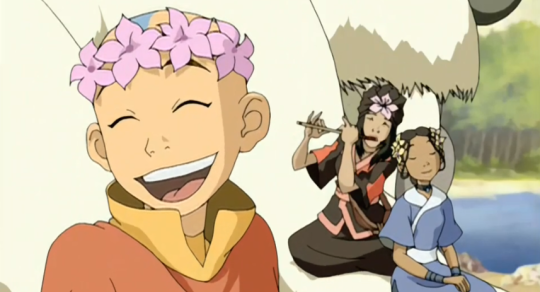
necklaces with pink flowers. He loves animals. He doesn’t eat meat. He despises
violence and spends nine tenths of every fight ducking and dodging. His only
“weapon” is a blunt staff, used more for recreation than combat. Through the
show, Aang receives most of his training from two young women – Katara and Toph
– whom he gives absolute respect, even to the point of reverence. When he
questions their instruction, it comes from a place of discomfort or anxiety,
never superiority. He defers to women, young women, in matters of strategy and
combat. Then he makes a joke at his own expense and goes off to feed his pet lemur.
Now
there’s a perfectly reasonable explanation for all this, and it’s the one that
shielded Aang from the heroic limelight in my eyes for ten years. The reasoning
goes like this: Aang is a child. He has no presumptuous authority complex, no
masculinity anxiety, no self-consciousness about his preferred pastimes,
because he’s twelve. He’s still the hero, but he’s the prepubescent hero, the
hero who can’t lead the charge himself because he’s just not old enough. The
problem is, that reasoning just doesn’t hold up when you look at him in the
context of the rest of the show.
Let’s
look at Azula. Aside from the Avatar himself, Zuko’s sister is arguably the
strongest bender in the entire show. We could debate Toph and Ozai all day, but
when you look at all Azula does, the evidence is pretty damning. Let’s make a
list, shall we?
Azula
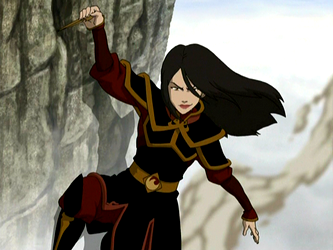
completely mastered lightning, the highest level firebending technique, in her
spare time on a boat, under the instruction of two old women who can’t even
bend.
Azula led
the drill assault on Ba Sing Sae, one of the most important Fire Nation
operations of the entire war, and almost succeeded in conquering the whole Earth
Kingdom.
Azula then
bested the Kyoshi Warriors, one of the strongest non-bender fighting groups in
the entire world, successfully infiltrated the Earth Kingdom in disguise,
befriended its monarch, learned of the enemy’s most secret operation,
emotionally manipulated her older brother, overthrew the captain of the secret
police and did conquer the Earth
Kingdom, something three Fire Lords, numerous technological monstrosities, and
countless generals, including her uncle, failed to do in a century.
And she
did this all when she was fourteen.
That last
part is easy to forget. Azula seems so much her brother’s peer, we forget she’s
the same age as Katara. And that means that when we first meet Azula, she’s
only a year older than Aang is at the end of the series. So to dismiss Aang’s
autonomy, maturity or capability because of his age is ridiculous,
understanding that he and Azula could have been in the same preschool class.
We must
then accept Aang for what he truly is: the hero of the story, the leader of the
charge, who repeatedly displays restraint and meekness, not because of his age,
not because of his upbringing, not because of some character flaw, but because
he chooses too. We clamor for strong female characters, and for excellent
reason. But nobody every calls for more weak
male characters. Not weak in a negative sense, but weak in a sense that he
listens when heroes talk. He negotiates when heroes fight. And when heroes are
sharpening their blades, planning their strategies and stringing along their
hetero love interests, Aang is making jewelry, feeding Appa, and wearing that
flower crown he got from a travelling band of hippies. If all Aang’s hobbies
and habits were transposed onto Toph or Katara, we’d see it as a weakening of
their characters. But with Aang it’s cute, because he’s a child. Only it isn’t,
because he’s not.
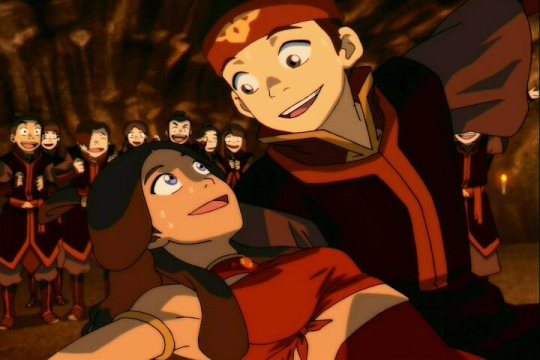
Even in
his relationship with Katara, a landmark piece of any traditional protagonist’s
identity, Aang defies expectations. From the moment he wakes up in episode one,
he is infatuated with the young woman who would become his oldest teacher and
closest friend. Throughout season one we see many examples of his puppy love
expressing itself, usually to no avail. But there’s one episode in particular
that I always thought a little odd, and that’s Jet.
In Jet, Katara has an infatuation of her
own. The titular vigilante outlaw sweeps her off her feet, literally, with his
stunning hair, his masterful swordsmanship and his apparent selflessness. You’d
think this would elicit some kind of jealousy from Aang. There’s no way he’s
ignorant of what’s happening, as Sokka sarcastically refers to Jet as Katara’s
boyfriend directly in Aang’s presence, and she doesn’t even dispute it. But
even then, we never see any kind of rivalry manifest in Aang. Rather, he seems
in full support of it. He repeatedly praises Jet, impressed by his leadership
and carefree attitude. Despite his overwhelming affection for Katara, he
evaluates both her and Jet on their own merits as people. There is no sense of
ownership or macho competition.
Contrast
this with Zuko’s reaction to a similar scenario in season three’s The Beach. Zuko goes to a party with his
girlfriend, and at that party he sees her talking to another guy. His reaction?
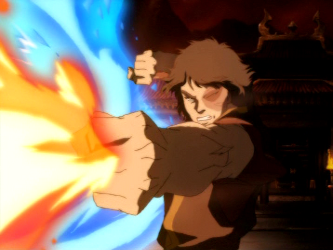
Throwing the challenger into the wall, shattering a vase, yelling at Mai, and
storming out. This may seem a little extreme, but it’s also what we’d expect to
an extent. Zuko is being challenged. He feels threatened in his station as a
man, and he responds physically, asserting his strength and dominance as best
he can.
I could
go on and on. I could talk about how the first time Aang trains with a
dedicated waterbending master, he tries to quit because of sexist double
standards, only changing his mind after Katara’s urging. I could talk about how
Aang is cast as a woman in the Fire Nation’s propaganda theatre piece bashing
him and his friends. Because in a patriarchal society, the worst thing a man
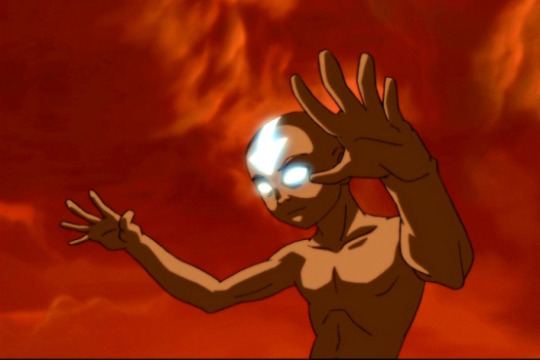
can be is feminine. I could talk about the only times Aang causes any kind of
real destruction in the Avatar state, it’s not even him, since he doesn’t gain
control of the skill until the show’s closing moments. Every time he is powerless
in his own power and guilt-ridden right after, until the very end when he finally
gains control, and what does he do with all that potential? He raises the
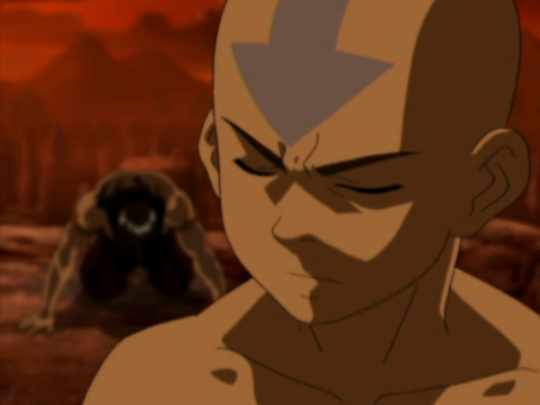
rivers, and puts the fires out.
Aang
isn’t what he’s supposed to be. He rejects every masculine expectation placed
on his role, and in doing so he dodges center stage of his own show. It’s
shocking to think about how many times I just forgot about Aang. Even at the
end, when his voice has dropped and his abs have filled in, we miss it. Zuko’s
coronation comes and we cheer with the crowd, psyched to see our hero crowned.
Then the Fire Lord shakes his head, gestures behind him and declares “the real
hero is the Avatar.” It’s like he’s talking to us. “Don’t you get it?” he asks.
“Did you miss it? This is his story. But you forgot that. Because he was small.
And silly. And he hated fighting. And he loved to dance. Look at him,” Zuko
seems to say. “He’s your hero. Avatar Aang, defier of gender norms, champion of
self-identity, feminist icon.”
Tenzin seems a few months old and Kya between 2 and 4 years old here. Bumi looks like he could be as old as 14 to me, particularly if we compare him to other kids in the show (he seems older than Aang was at the end of ATLA and perhaps even Kai in Book 4 – was he just awkwardly tall?). I think I remember one of the Bryke saying he was entering his awkward stage or something, so I’d say 10 is the very minimum.
Tenzin was born when Aang was 32. So if Bumi is 10-14 in the photo, it means Aang would have had him when he was somewhere between 18 (!!!) (*) and 22 years old. Tenzin (kinda) remembers playing with Bumi when he was little though (and it’s hard to believe he was nearly 70 in LoK Book 4), so a 10-12 years age difference may be more likely than a 14 years one?
Headcanon timeline: 107/8 AG: Bumi is born. Katara is 22/23, Aang 20/21. 116 AG: Kya is born. Katara is 31, Aang 29, Bumi 9/8. 119 AG: Tenzin is born. Katara is 34, Aang 32, Bumi 12/11 and Kya 3.
(*) I actually don’t think it’s impossible for Aang (and Katara) to have Bumi this young:
Throughout the Legend of Korra, the myth of the “idealized family” is challenged and torn-down, from Hiroshi secretly working with the Equalists, to the Beifong’s exceedingly complicated dynamics. Yet Katara and Aang’s rather traditional, nuclear family particularly stands out. Going into the series, I think it wouldn’t have been shocking for anyone to say “Toph would be a really weird mother.” But Aang and Katara felt like two characters who could develop into pretty great parents. Learning that things were less than rosey for their children was jarring. This is an attempt to unpack and explore the sibling dynamics of Bumi, Kya, and Tenzin. For the purposes of this essay, I’ll be referring to their family as “The Kataangs” (why can’t more people have last names). I felt it would constructive to divide this essay by the individuals. For the purposes of our understanding, in Books 2 and 3, when these guys mostly interact, Tenzin is 52, and based on semi-canonical sources, that puts Kya at 55/56 and Bumi at 62.




 midnight-in-town