Thanks to another blogger’s recent post about the attackers at Phantomhive manor (sorry, I don’t recall the OP), I’ve noticed something I hadn’t before. They provided this picture:
…showing that Tanaka must have been stabbed or slashed in his side before being stabbed in the back.
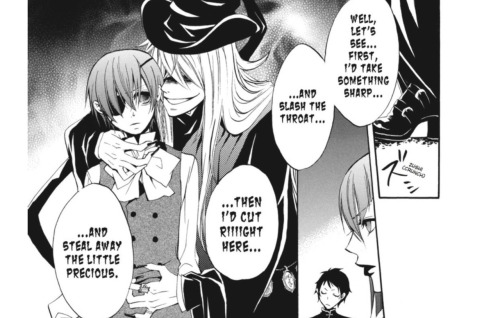
And where else have we seen this?
More evidence that these attackers are the same person?
Does Undertaker refer to taking the ring from Real Ciel in Vol 2?
In the Ripper arc when Undertaker demonstrates where organs were harvested from the victims, he uses Our Ciel as a prop to show where the girls’ abdomens were mutilated.
I wonder if he did that on purpose knowing that Our Ciel would have a good reason to be uncomfortable with the idea of a kid like him being gutted like that.
If the Ciel who showed up at the manor is a “Real” Ciel, one of the unanswered mysteries of the series is how his body could have been preserved when the cultists’ building burned down.
It’s possible Undertaker was hiding there to collect the body. If he was, he would know how Our Ciel and Sebastian collected the ring.
(Volume 2 pg 59)
Even “steal the little precious” sounds like he’s alluding to the ring.
Olaf’s parting words are a direct quotation of Philip Larkin’s “This Be The Verse” (Link). One of the reasons the poem isn’t quoted in full is that it contains profanity.
They fuck you up, your mum and dad. They may not mean to, but they do. They fill you with the faults they had And add some extra, just for you. But they were fucked up in their turn By fools in old-style hats and coats, Who half the time were soppy-stern And half at one another’s throats. Man hands on misery to man. It deepens like a coastal shelf. Get out as early as you can, And don’t have any kids yourself. [Philip Larkin, “This Be The Verse” from “Collected Poems”]
I would argue that Olaf chooses this poem for two purposes.
One is to contradict the false narrative that the Baudelaire orphans (and the “noble” side of V.F.D. in general) have built up in their heads: that education automatically leads to moral progress, and that evil people are usually ignorant.
“I know that having a good vocabulary doesn’t
guarantee that I’m a good person,” the boy said. “But it does mean I’ve read a great deal. And in my experience,
well-read people are less likely to be evil.” [The Slippery Slope, Chapter Five]
Of course, there is not usually a lightbulb hovering in
the air when someone has an idea, but the image of a lightbulb over
someone’s head has become a sort of symbol for thinking, just as the image of an eye, sadly, has
become a symbol for crime and devious behavior rather than integrity, the prevention of fire, and being
well-read. [The Slippery Slope, Chapter Eleven]
“Well-read!” she repeated in a particularly
nasty tone of voice. “Being well-read won’t help you in this world. Many years ago, I was supposed to waste my
entire summer reading Anna Karenina, but I knew that silly book would never help me, so I threw it
into the fireplace.” She reached down and picked up a few more pieces of wood, which she tossed aside
with a snicker. “Look at your precious headquarters, volunteers! It’s as ruined as my book.
And look at me! I’m beautiful, fashionable, and I smoke cigarettes!” She laughed again, and pointed
at the children with a scornful finger. “If you didn’t spend all your time with your heads stuck in books,
you’d have that precious baby back.” [The Slippery Slope, Chapter Twelve]
Although the “villainous” side of V.F.D has a strong anti-intellectual stance, Olaf’s actions contradict this ideology (many of his plans do require a strong dose of research and literary knowledge). He goes as far as writing his own plays under a pseudonym (”Al Funcoot”), probably because he doesn’t want people to realize he actually enjoys literature.
So Olaf’s decision to prove he can recite poems is a fantastic case of duality. On one hand, he’s getting back to the days of his education by V.F.D., with a strong emphasis on the love of literature. On one hand, he’s such a wicked person that it’s a criticism of V.F.D.’s ideology at the same time. None of the endoctrination seemed to do him much good. But it’s possible he does look back fondly on his past appreciation for poetry as it’s strongly tied to the happy memories he had growing up with Kit.
“‘The night has a thousand eyes,’” Kit said hoarsely, and lifted her head to face the villain. The Baudelaires could tell by her voice that she was reciting the words of someone else. ’“And the day but one; yet the light of the bright world dies with the dying sun. The mind has a thousand eyes, and the heart but one: yet the light of a whole life dies when love is done.’” Count Olaf gave Kit a faint smile. “You’re not the only one who can recite the words of our associates,” he said, and then gazed out at the sea. The afternoon was nearly over, and soon the island would be covered in darkness. ’“Man hands on misery to man,’” the villain said. “’It deepens like a coastal shelf. Get out as early as you can–’” Here he coughed, a ghastly sound, and his hands clutched his chest. “’And don’t have any kids yourself,’” he finished, and uttered a short, sharp laugh. [The End, Chapter Thirteen]
Although the “villainous” side of V.F.D has a strong anti-intellectual stance, Olaf’s actions contradict this ideology (many of his plans do require a strong dose of research and literary knowledge). He goes as far as writing his own plays under a pseudonym (”Al Funcoot”), probably because he doesn’t want people to realize he actually enjoys literature.
The second purpose of the poem is to cast a cynical, uncomfortable light on Olaf’s own life. As we learn in “The Penultimate Peril”, Olaf was orphaned at an early age by the Baudelaire parents, an event which may have been the triggering event on his path to villainay. Olaf’s response was to make Beatrice and Bertrand’s children orphans in turn and to inflict every misery he had suffered on to them. So he’s effectively become the very kind of person he hates. There’s a strong parallel with Larkin’s poem, which speaks of the incapacity to become a “proper” parent even though you’ve seen and experienced bad parenting while you were a child. It’s an ontological cycle of violence from which there is no escape. Olaf’s nefarious nihilism is strongly tied to this horrible realization.
It’s of course no wonder that the adoption of Carmelita Spats is what causes the Esme/Olaf break-up. While Esme is delighted to obtain a child to shape into her own image, Olaf seems extremely uncomfortable around Carmelita. The fact they apparently plan to steal Carmelita’s inheritance anyway only makes it worse. Anything that resembles parenting creepsout Olaf. So it only makes sense that he utters this poem with one last maniacal laugh, as the woman he once loved dies giving birth to the child he could have raised with her.
The matter is deliberately left ambiguous by the author, and that’s just as it should be: Kit and Dewey and Olaf are all dead now, so Lemony has no way to prove Beatrice’s paternity with any degree of certainty.
All we know is that Kit had made some manner of arrangements for Beatrice’s birth and seemed confident that Beatrice would be raised in a stable home:
I’ve scarcely looked at these maps, poems, and blueprints that Charles sent me, or chosen wallpaper for the baby’s room. […] “I know I don’t have to tell you how terrible it feels to lose a family member. I felt so terrible that I vowed I would never leave my bed.” “What happened?” Klaus said. Kit smiled. “I got hungry,” she said, “and when I opened the refrigerator, I found another message waiting for me.” [Kit Snicket & Klaus Baudelaire – The Penultimate Peril, Chapter Two]
There’s also these passages which seem to confirm Dewey and Kit were romantically involved:
For another terrible moment, it felt like the boat was going to sink into the water, just as Dewey Denouement had sunk into the pond, guarding his underwater catalog and all its secrets, and leaving the woman he loved pregnant and distraught. [Lemony Snicket – The Penultimate Peril, Chapter Thirteen]
“I knew you ran into danger there,” Kit said. “We were watching the
skies. We saw the smoke and we knew you were signaling us that it
wasn’t safe to join you. Thank you, Baudelaires. I knew you wouldn’t fail
us. Tell me, is Dewey with you?” [Kit Snicket – The End, Chapter Eight]
Note that this passage betrays her attachment to Dewey since she momentarily forgets that she purposefully hid Dewey’s existence from the Baudelaires in “The Penultimate Peril”. One of the first questions she asks the Baudelaires as she emerges from the wreck is Dewey’s location. Dewey clearly is of prime importance to her. So I would agree with the interpretation that they were in a relationship and that Dewey was supposed to act as Beatrice’s father.
Of course, that doesn’t necessarily mean Dewey is her father in the biological sense. We know that books 1 to 13 of “A series of Unfortunate Events” happen over less than a year because the Baudelaires celebrate their birthdays. So it’s entirely possible that Beatrice was conceived BEFORE the Baudelaire fire, at a time when the hostility between both sides of VFD wasn’t really as bad as it used to be, or when Olaf had shown (deceitful) signs of wanting to change his ways. Kit could have been seduced or succombed to her passion until the news of her friends’ murder got out.
Another disturbing possibility to consider is that Kit was raped. Given Olaf’s history of intended pedophily and marital rape, it’s definitely not out of the equation.
All in all Kit’s and Olaf’s past affair seems to come out of the blue in “The End”, but it’s probably intentional: it’s supposed to remind the Baudelaires that the world is a complicated place and that it may still surprise them. People are neither noble nor wicked, they’re just chef’s salads. That said, the fact that the Baudelaires end up as guardians of Olaf’s potential bastard may be the ultimate irony.
What’s interesting is that Violet, just like Kit’s child, was supposed to be born on the Island until Beatrice was banished… And there’s also some suspicion that she may be Lemony’s biological daughter. But in that case too, Lemony seems to value nurture over nature. He doesn’t give much thought about whose DNA Violet or Beatrice Jr descended from. Dewey and Bertrand were the fathers these women chose for their child, and that’s the only relevant part.
That is what I’m hoping. It’s really hard to tell how we should be taking this, which is why I’m eager to get the Jaimini’s Box translation even if we have to wait for it. They tend to be more careful with their wording, and I’m very curious for the specific wording of those lines.
Like, in the past, Kaneki’s I WANT TO PROTECT EVERYONE AND I WILL NOT LOSE has literally. Every time. Signified that the dude is going to lose. However, he made a pretty important acknowledgement here: that he can’t protect anyone. That he can’t win. That he’s not nearly as smart or as strong as Furuta. Therefore, what I’m guessing Kaneki is saying he’s fighting for is, well, love. the love he has from humans and ghouls who dug his ass out of a stinky Dragon.
However, I do think there is an important revelation Kaneki still needs to have, and that’s to empathize with Furuta. I still am betting the fight ends with that, and Furuta ends around 176–either the fight or Furuta’s life, hopefully just the fight.
I still have 0 idea what’s up with Kaneki’s body/kagune (did it mutate somehow? then again Kimi doesn’t know either so I think that’s normal), but the phoenix imagery is really strong again at the end of the chapter.
so it’s really as if Kaneki’s body is working like nothing we saw before (hence Kimi’s confusion I guess as well as those new organs she mentioned).
Can’t wait to see what this gives for next week. :3
The more I look at it, the more I feel as if his body became a real kagune armor that he can control at will.
That’s why after he used it the first time and retracted it…
he gained his hands back?
And his little mark under the eyes, it looks to be a result of the veins/Rc pathways going to his eyes (see above) after he went all out in ch164.
So maybe that actually explains why there is no kakugan anymore and why this mark expands when he fights: there is no flow of Rc cells to his eyes anymore (thus no kakugan) because instead they’re possibly cleared out through these little marks under his eyes that represent Rc pathways/veins.
Frankly I don’t know, feel free to hit me up with ideas about how his body works, if you’ve got any!
Either that or she’s referring to UT’s confession that he was the one who retrieved RC’s body (and thus must also be the the person who revived him) since imo that was the biggest revelation in this chapter.
I mean, there were a lot of foreshadowing that UT must be somehow involved in RC’s resurrection (ch108, ch109, ch120, tokuten illustration, etc), so maybe Yana was like “I dropped lots of hints so I assume some people already saw this plot twist coming, but yeah anyway, here it is! Finally, he (UT) admitted that he was the one who’s responsible for RC’s return!”. But honestly, idk ¯_(ツ)_/¯
I’ll just wait until tomorrow and then check other Japanese fans’ reviews of this chapter. Maybe they’ll come up with a more plausible interpretation of Yana’s latest tweet than mine^^;




 midnight-in-town