Yes, I have a lot of these asks in my inbox so I hope I can cover them all in one go.
Alright I am going to do my best dissection of the last chapter. This is strictly from an interpretive perspective and not an opinion based one. Opinion based I have no real strong opinions on the ending beyond “it sure was an ending.”
I’ve already come out and said I was expecting an ending for Tokyo Ghoul: Re for a long time and got pretty much what I was expecting leaving me mostly neutral. I’ve also avoided talking about it for around two weeks so. There is the disclaimer.
So more than anything else I read the ending as bittersweet. Remember this was not a peace achieved by diplomacy, but rather by the forming of a common enemy. Not only that but the common enemy is literally compared to “newborns” and “orphans.”
I made a meta a long time ago, you can read it [here] that those the most abused and mistreated by society are also those who end up being scapegoats and forgotten. The oggai are all thirteen to fifteen year old children who were turned into child soldiers, mainly because there was a system in place already that adopted orphans and manipulated them to hate ghouls, and so their deaths go mainly forgotten by the story to reflect their status in the world. Of course the Oggai are forgotten and not even mentioned in the epilogue, they were orphans, there was nobody to remember them in the first place.
This isn’t a criticism this is reflective of a theme. Those who are the most abused by society, those who are the worst victims, those who are manipulated often aren’t saved. We see that time and time again in Tokyo Ghoul and it’s even heavily present in the epilogue.
I am arguing author intent here, that Ishida left those elements in to purposefully make the ending bittersweet, or even melancholy. I’m not even specifically talking about who to blame for the deaths of the Oggai, just that in a better world steps would have been taken to make sure the tragedy never repeats itself again. However, the ending shows us that is not the case because the world of Tokyo Ghoul is not a world that’s been reborn anew after being destroyed but one that slowly changes after great fighting.
A lot of the problems of the CCG still persist, even if they’ve been reformed and renamed. Just the strongest shining example is given to us by Ishida himself. Six years after the fact, after the supposed reform of the CCG, nobody still thought to fire the teacher with an obvious history of abuse of prisoners and children. Which means that the CCG academy that acted as a pipeline for orphans to be made directly into good CCG officers is still mostly in tact, and also that once again the CCG values efficiency and skill over actual ethics. Tokage gave a knife to Mutsuki and told him how to better kill cats, but if the CCG had raised Mutsuki with the intent of allowing a damaged orphan to re-enter society rather than just raising them to be another weapon to point at ghouls then they never would have allowed Tokage to stay employed by them in the first place. The fact that Tokage wasn’t simply fired and that an actual child had to stab him to death before they took any action shows that this part of the CCG still stagnates.
There’s also CCG branches that are still, just the normal CCG and not the reformed TSG that cooperates with ghouls. It’s also quite obvious that the characters who were the least sympathetic with ghouls (Kuramoto and Mutsuki in particular) transferred there and just act like normal CCG officers, and not reformed TSC officers who fight side by side with ghouls.
Yusa’s fate is rather sad as well. I don’t think I’m alone in saying pretty much everybody wanted the zero squad and garden kids in general to escape the CCG and be able to live a normal life. There is a lot of fighting to do yes, but perhaps it should be handled by the people who were not raised as child soldiers.
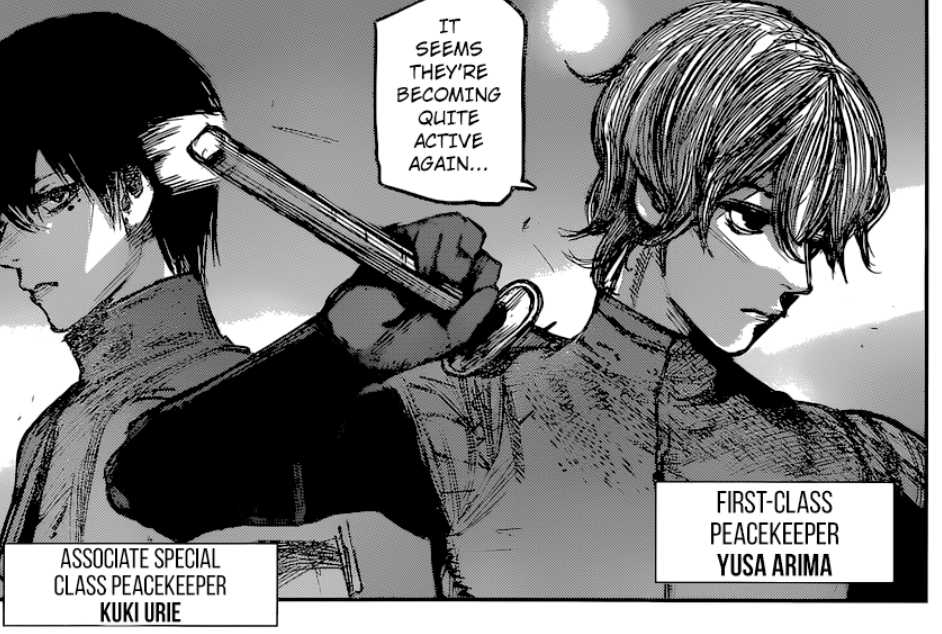
Yusa Arima in particular seems like a tragic example of this. It’s said quite clearly that he wanted to exist in the world outside of battles, yet we see him in the epilogue.
Not only has he remained a CCG officer, he’s fighting even while undergoing early aging. People are even trying to honor him by fighting until he reaches an early grave by putting the name Kishou on him, but that’s quite literally missing the point.
Arima’s wish was to escape the fighting, so it’s rather tragic the last living member of the garden kids in zero squad isn’t really given that opportunity at all. Rather, he’s fighting until his hair grays and people start calling him a second Arima completely ignorant to the wishes of the first Arima, but again this was built up.
Are we ever going to reach the perfect world Arma wished for? Or are we stuck currently in the one we’re in, that was the last ambiguous note that Yusa’s arc ended on.
So continuing on, I made a big deal on how a society that was better would at least make sure never to repeat the mistake of the Oggai, but what we see here is a continuation of the Q’s.
No questions asked from the one hundred Q orphans that specifically exploited this program and the science behind it to not only kill 100 children but create the monster that was dragon, well they make good weapons so might as well make more of them.
Considering that a few of the test subjects are also garden children who probably were child soldiers who can’t consent to this operation that much, I would say the fact that more Q’s are being produced is definitely meant to be read as shady.
This is specifically what Furuta says in “Good News” as well, that the Oggai are the next generation Q’s, as in they are what the Q’s are in danger of becoming. Knowing that, learning from the horrible destruction of the Oggai any organization really should have halted the project entirely but that’s not what we see happen. The dangers are ignored because they make convenient weapons.
So, finally the “There were ghouls that continued to rail against humankind.”
Using Shikorae as the example of the most dangerous, most inhuman ghoul possible just underlies the point of what I said earlier that Tokyo Ghoul depicts a world where the weak and abused are still scapegoated and forgotten about. That is the entire point of Rio’s character, he has a video game where he makes clear parallels to Kaneki and when he’s treated with violence he becomes more violent, but when he’s treated with kindness he becomes a brave and kind person who works side by side with those at Anteiku and even can save Kaneki or wait for him to return in Re:.
So the fact that Shikorae is used as an example of a ghoul that monstrously fights against the CCG, not only in the ending but also in Amon’s monologue towards the end.
When, Shikorae is literally a ghoul who was living peacefully scavenging with his brother who just happened to be born neuroatypical with an unstable persnonality, that only became reduced to his Shikorae state because he was tortured to insanity by a CCG Officer, who was allowed to do so because of the CCG’s lack of scruples with how ghouls are treated, shows that there’s still a lack of empathy for those monstrous ghouls who become victims.
I mean we see the only character that empathizes or treats Shikorae with any kind of humanity at all in the whole series, is Roma of all people.
So this theme still persists, of dehumanizing your enemies. Shikorae turns into a horrible monster because he was treated that way all the way until the end. It also worries me what the Dragon Orphans are going to be treated like once they evolve to the point of having actual human like intelligence and stop being mob monsters that both sides can slaughter without remorse.
Also, ghouls like Takizawa who really are victims of circumstance, and who could have been saved with the tiniest amount of outreach instead are living entirely alone, trying to pursue a half redemption by just becoming a vigilante proves that reconciliation is not one hundred percent. I have been saying this a long time but it really does read that Amon and Akira forgot about Seidou, to the point where we’re deliberately shown a panel of Seidou’s loneliness and lonely fate contrasted with their happiness together.
That is basically what was built up in the story though. Amon and Akira find their happiness, but only by leaving everything else behind entirely and focusing on each other. They did not show up when Goat needed them until the very end when somebody else told them to. Akira never tried to bury Fueguchi for Hinami’s sake. They only found peace with themselves and not others, and hence we get only the briefest of narrations for their fates.
Also what happens to Mutsuki is to me just as tragic as what happened with Seidou. The last note of Mutsuki’s arc was that the Q’s would never let him drift away again, only to have him drifting away in the epilogue. There was also a large subplot on how Mutsuki really was using ghouls as a way to kill in an acceptable way and vent their urge to kill, and we see Mutsuki and Kuramoto choose instead not to join the united front but the regular CCG that just kills normal ghouls.
It makes sense though given what was written before this. The fact that Mutsuki saw ghouls as acceptable targets to kill was never addressed in story. The same way that Urie still six years later is bringing up promotion first in regards to Mutsuki rather than his actual feelings, because Urie never in story moved past caring about the pecking order of the CCG, the chain of command, and achievement through promotion first and foremost.
So, we’re left with a world that kind of mirrors the old one in a way. The old CCG boy’s club, those that profitted off of become career long investigators, those who lived lifes of privilege continue to live in that privilege. Whereas those who were at the bottom remain at the bottom, torture victims like Seidou, human experimentation victims like Kurona, child soldiers like Furuta. They are either alone, dead, or dead inside and alone.
Even garden children are still being exploited as soldiers. Hsiao works until she starts to slowly die from her aging, and only then does anybody think to try treating her for her half ghoul condition, and then only so she can return to work as well.
The world depicted in the ending in my reading is a world that is changing slowly, but that’s slightly better off than a caged world which refused to change at all.
So, on a final note there are people calling this an ending “too happy” for Tokyo Ghoul, even though there are all of these tragic and melancholy elements that I pointed out are there if you just read closely.
I think it’s more of a case of people reading Kaneki’s happy ending and then applying it to everybody else. However, Kaneki’s writing is nothing if not consistent to me.
He’s said several times that he doesn’t particularly care about the opinions of the rest of the world, or even the vast majority of people he just wants to carve out his small corner of happiness to live in.
Kaneki not really caring about the vast majority of people, and instead continually fighting for his own little corner of happiness, and able to live because he has those people around him even if it’s a life of constant struggle.
So that’s my take anyway. Tokyo Ghoul depicts an incredibly flawed world. Some of those flaws are resolved, some of them are not and we see that portrayed in a bitter sweet ending, but with one that tells us that the world can slowly change even if it’s not in the best version of itself right now.
Random guy 1: Excuse me. Random guy 2: Ooooops I’m sorry. Random guy3: My hand slipped!! Mikasa: Dark knight! Armin: What did you do, Eren?! There is a rumor saying you did horrible things to Historia!? Eren: …Historia?
Historia: Shoot… Didn’t think my word could create such a scene… Why did these guys spread nonsense like that?! So they didn’t tell the truth and save those poor students who are fooled by groundless rumors?! … I beg you all to stop putting on a face like a justice enforcer who issued a judgement to the bad people!! Historia: Ahhhh… What should I do… If I confess it’s me who said a nonsense, I don’t know what will happen to me… Ugh, oh no, they are coming this way!! Historia: …… I’ll apologize. If I face you wholeheartedly, you will understand me. Eren: Who are you? Why don’t you speak out what I’ve done? Historia: … Why not you just ask your heart? You should know, shouldn’t you?




 midnight-in-town